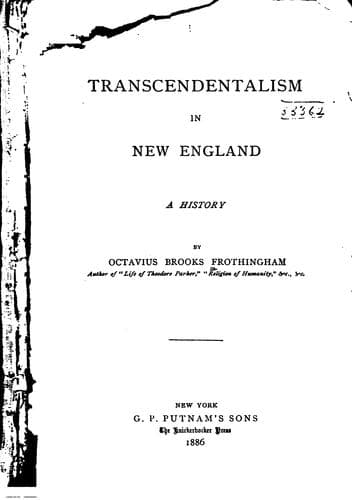
Transcendentalism in New England: A HistoryFrothingham, Octavius Brooks
Philosophy
Transcendentalism in New England: A History
Frothingham, Octavius Brooks
Transcendentalism (New England)
Without presuming to fix precisely the purpose in the mind of Jesus, you
will see that many opinions may be entertained of his intention, all
consistent with the opinion that he did not design a perpetual
ordinance. He may have foreseen that his disciples would meet to
remember him, and that with good effect. It may have crossed his mind
that this would be easily continued a hundred or a thousand years--as
men more easily transmit a form than a virtue--and yet have been
altogether out of his purpose to fasten it upon men in all times and all
countries.
But though the words, _Do this in remembrance of me_, do not occur in
Matthew, Mark, or John, and although it should be granted us that, taken
alone, they do not necessarily import so much as is usually thought, yet
many persons are apt to imagine that the very striking and personal
manner in which this eating and drinking is described, indicates a
striking and formal purpose to found a festival. And I admit that this
impression might probably be left upon the mind of one who read only the
passages under consideration in the New Testament. But this impression
is removed by reading any narrative of the mode in which the ancient or
the modern Jews have kept the Passover. It is then perceived that the
leading circumstances in the Gospels are only a faithful account of that
ceremony. Jesus did not celebrate the Passover, and afterwards the
Supper, but the Supper _was_ the Passover. He did with his disciples
exactly what every master of a family in Jerusalem was doing at the same
hour with his household. It appears that the Jews ate the lamb and the
unleavened bread, and drank wine after a prescribed manner. It was the
custom for the master of the feast to break the bread and to bless it,
using this formula, which the Talmudists have preserved to us, "Blessed
be Thou, O Lord our God, the King of the world, who hast produced this
food from the earth,"--and to give it to every one at the table. It was
the custom of the master of the family to take the cup which contained
the wine, and to bless it, saying, "Blessed be Thou, O Lord, who givest
us the fruit of the vine,"--and then to give the cup to all. Among the
modern Jews who in their dispersion retain the Passover, a hymn is also
sung after this ceremony, specifying the twelve great works done by God
for the deliverance of their fathers out of Egypt.
Public-domain text, read in full here on John Shaqi.
Reviews
Reviews
No reviews yet
Be the first to share your thoughts on this work.
Elsewhere in the archive
Join the Discussion
Join the discussion
Sign in to leave a comment or review.
Sign InorCreate an account