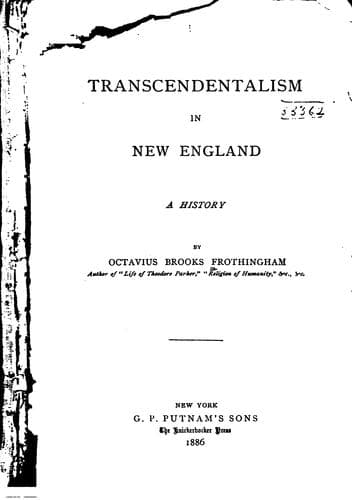
Transcendentalism in New England: A HistoryFrothingham, Octavius Brooks
Philosophy
Transcendentalism in New England: A History
Frothingham, Octavius Brooks
Transcendentalism (New England)
2. It has seemed to me that the use of this ordinance tends to produce
confusion in our views of the relation of the soul to God. It is the old
objection to the doctrine of the Trinity,--that the true worship was
transferred from God to Christ, or that such confusion was introduced
into the soul, that an undivided worship was given nowhere. Is not that
the effect of the Lord's Supper? I appeal now to the convictions of
communicants--and ask such persons whether they have not been
occasionally conscious of a painful confusion of thought between the
worship due to God and the commemoration due to Christ. For, the service
does not stand upon the basis of a voluntary act, but is imposed by
authority. It is an expression of gratitude to Christ, enjoined by
Christ. There is an endeavor to keep Jesus in mind, whilst yet the
prayers are addressed to God. I fear it is the effect of this ordinance
to clothe Jesus with an authority which he never claimed and which
distracts the mind of the worshipper. I know our opinions differ much
respecting the nature and offices of Christ, and the degree of
veneration to which he is entitled. I am so much a Unitarian as this:
that I believe the human mind cannot admit but one God, and that every
effort to pay religious homage to more than one being, goes to take away
all right ideas. I appeal, brethren, to your individual experience. In
the moment when you make the least petition to God, though it be but a
silent wish that he may approve you, or add one moment to your life,--do
you not, in the very act, necessarily exclude all other beings from your
thought? In that act, the soul stands alone with God, and Jesus is no
more present to the mind than your brother or your child.
But is not Jesus called in Scripture the Mediator? He is the mediator in
that only sense in which possibly any being can mediate between God and
man--that is an Instructor of man. He teaches us how to become like God.
And a true disciple of Jesus will receive the light he gives most
thankfully; but the thanks he offers, and which an exalted being will
accept, are not _compliments_--commemorations,--but the use of that
instruction.
3. Passing other objections, I come to this, that the _use of the
elements_, however suitable to the people and the modes of thought in
the East, where it originated, is foreign and unsuited to affect us.
Whatever long usage and strong association may have done in some
individuals to deaden this repulsion, I apprehend that their use is
rather tolerated than loved by any of us. We are not accustomed to
express our thoughts or emotions by symbolical actions. Most men find
the bread and wine no aid to devotion and to some, it is a painful
impediment. To eat bread is one thing; to love the precepts of Christ
and resolve to obey them is quite another.
Public-domain text, read in full here on John Shaqi.
Reviews
Reviews
No reviews yet
Be the first to share your thoughts on this work.
Elsewhere in the archive
Join the Discussion
Join the discussion
Sign in to leave a comment or review.
Sign InorCreate an account