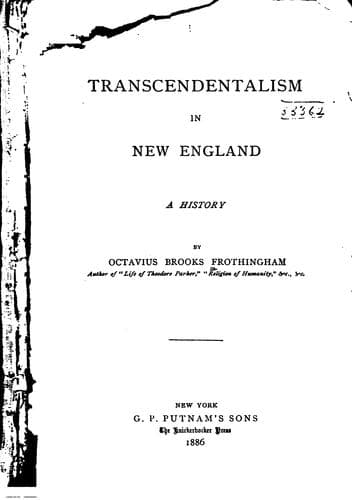
Transcendentalism in New England: A HistoryFrothingham, Octavius Brooks
Philosophy
Transcendentalism in New England: A History
Frothingham, Octavius Brooks
Transcendentalism (New England)
The statement of this objection leads me to say that I think this
difficulty, wherever it is felt, to be entitled to the greatest weight.
It is alone a sufficient objection to the ordinance. It is my own
objection. This mode of commemorating Christ is not suitable to me. That
is reason enough why I should abandon it. If I believed that it was
enjoined by Jesus on his disciples, and that he even contemplated making
permanent this mode of commemoration, every way agreeable to an eastern
mind, and yet, on trial, it was disagreeable to my own feelings, I
should not adopt it. I should choose other ways which, as more effectual
upon me, he would approve more. For I choose that my remembrances of him
should be pleasing, affecting, religious. I will love him as a glorified
friend, after the free way of friendship, and not pay him a stiff sign
of respect, as men do to those whom they fear. A passage read from his
discourses, a moving provocation to works like his, any act or meeting
which tends to awaken a pure thought, a flow of love, an original
design of virtue, I call a worthy, a true commemoration.
4. Fourthly, the importance ascribed to this particular ordinance is not
consistent with the spirit of Christianity. The general object and
effect of this ordinance is unexceptionable. It has been, and is, I
doubt not, the occasion of indefinite good; but an importance is given
by Christians to it which never can belong to any form. My friends, the
apostle well assures us that "the kingdom of God is not meat and drink,
but righteousness and peace and joy, in the Holy Ghost." I am not so
foolish as to declaim against forms. Forms are as essential as bodies;
but to exalt particular forms, to adhere to one form a moment after it
is out-grown, is unreasonable, and it is alien to the spirit of Christ.
If I understand the distinction of Christianity, the reason why it is to
be preferred over all other systems and is divine is this, that it is a
moral system; that it presents men with truths which are their own
reason, and enjoins practices that are their own justification; that if
miracles may be said to have been its evidence to the first Christians,
they are not its evidence to us, but the doctrines themselves; that
every practice is Christian which praises itself, and every practice
unchristian which condemns itself. I am not engaged to Christianity by
decent forms, or saving ordinances; it is not usage, it is not what I do
not understand, that binds me to it--let these be the sandy foundations
of falsehoods. What I revere and obey in it is its reality, its
boundless charity, its deep interior life, the rest it gives to my
mind, the echo it returns to my thoughts, the perfect accord it makes
with my reason through all its representation of God and His Providence;
and the persuasion and courage that come out thence to lead me upward
and onward. Freedom is the essence of this faith. It has for its object
simply to make men good and wise.
Public-domain text, read in full here on John Shaqi.
Reviews
Reviews
No reviews yet
Be the first to share your thoughts on this work.
Elsewhere in the archive
Join the Discussion
Join the discussion
Sign in to leave a comment or review.
Sign InorCreate an account