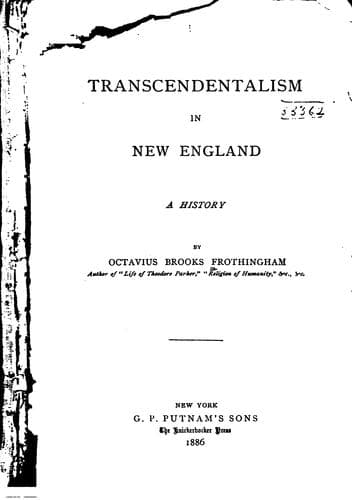
Transcendentalism in New England: A HistoryFrothingham, Octavius Brooks
Philosophy
Transcendentalism in New England: A History
Frothingham, Octavius Brooks
Transcendentalism (New England)
As has been already remarked, the transcendental faith found expression
in magazines and newspapers, which it called into existence, and which
no longer survive. Its elaborate compositions were, from the nature of
the case, few; its intellectual occupancy was too brief for the creation
of a permanent literature. Had Transcendentalism been chiefly remarkable
as a literary curiosity, the neglect of the smallest scrap of paper it
caused to be marked with ink would be culpable. As it was, primarily and
to the end, an intellectual episode, turning on a few cardinal ideas, it
is best studied in the writings and lives of its disciples. They knew
better than any body what they wanted; they were best acquainted with
their own ideas, and should be permitted to speak for themselves.
Earnest men and women no doubt they were; better educated men and women
did not live in America; they were well born, well nurtured, well
endowed. Their generation produced no warmer hearts, no purer spirits,
no more ardent consciences, no more devoted wills. Their philosophy may
be unsound, but it produced noble characters and humane lives. The
philosophy that takes its place may rest on more scientific foundations;
it will not more completely justify its existence or honor its day.
THE END.
INDEX.
A.
Alcott, Bronson, contributes to "The Dial," 133;
on the transcendental philosophy, tribute to Emerson quoted, 246;
the mystic, 249;
a follower of Pythagoras, 251;
"_Concord Days_" quoted, 255;
a leader of the transcendentalists, 257;
school in Cheshire, Conn., 262;
school in England named for, 267;
presides at reform meetings in England, 272;
superintendent of schools, 275;
his conversations, 283;
writings of, 358.
Alcott, Wm. A., writes on physical training, 262.
Alexandria, school of, 61.
American Unitarian Association, tract published by, 120.
Aristotle, categories of, 111.
Arius, advocate of Unitarian philosophy, 109.
B.
Bacon, Lord Francis, Macaulay on his philosophy, 139.
Bain, principles of the sensational philosophy stated by, 205.
Bancroft, George, his account of Herder, 47;
History of the United States quoted, 117;
champion of the spiritual philosophy, 117, 118;
traces of transcendentalism in his historical writings, 381.
Barni, Jules, translates Kant into French, 61.
Bartol, C. A., belongs to the transcendental school, 341.
Baur, follower of the Hegelian ideas, 186.
Biblical repository, articles on transcendentalism in, 137.
Bibliotheca Sacra, article on transcendentalism in, 92.
Biographia Literaria, of Coleridge, quoted, 82;
criticised by Edinburgh Review, 91;
Wordsworth's poetry considered in, 97.
"Blithedale Romance," published by Hawthorne, 175.
Blodgett, Levi, nom de plume of Theodore Parker, 125.
Boehme, Jacob, doctrine of, 257.
Boston Quarterly Review started by O. A. Brownson, 128.
Bouillet translates Plotinus, 61.
Public-domain text, read in full here on John Shaqi.
Reviews
Reviews
No reviews yet
Be the first to share your thoughts on this work.
Elsewhere in the archive
Join the Discussion
Join the discussion
Sign in to leave a comment or review.
Sign InorCreate an account