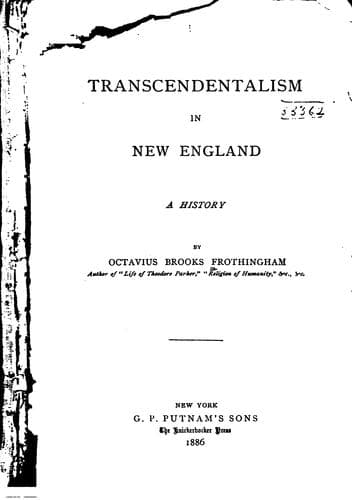
Transcendentalism in New England: A HistoryFrothingham, Octavius Brooks
Philosophy
Transcendentalism in New England: A History
Frothingham, Octavius Brooks
Transcendentalism (New England)
In poetry the influence is distinctly traceable, though here also it was
confined within somewhat narrow limits. Bryant betrays scarcely
perceptible marks of it, though he ascribed to Wordsworth a fresh
inspiration of love for nature. It is hardly perceptible in Longfellow,
whose verse, bubbling from the heart, gently meanders over the meadows
and through the villages, gladdening daily existence with its music.
Neither Bryant nor Longfellow had the intellectual passion that
Transcendentalism roused. The earlier pieces of Lowell, the anti-slavery
lyrics and poems of sentiment, were inspired by it. Whittier was wholly
under its sway. The delicious sonnets of Jones Very were oozings from
its spring. Julia Ward Howe's "Passion Flowers," though published as
late as 1854, burn and throb with feeling that had its source in these
heights.
The writers of elegant literature, essays, romances, tales, owed to
Transcendentalism but a trifling debt, not worth acknowledging. They
were out of range. It was their task to entertain people of leisure, and
they derived their impulse from the pleasure their writings gave them or
others. It was not to be expected that authors like Irving, Paulding,
Cooper, would feel an interest in ideas so grave and earnest, or would
catch a suggestion from them. But Lydia Maria Child, whose "Letters from
New York"--1841, 1843--were models in their kind; whose stories for
young people have not been surpassed by those of any writer, except
Andersen; whose more labored works have a quality that entitles them to
a high place among the products of mind, is a devotee of the
transcendental faith. A very remarkable book in the department of
fiction was Sylvester Judd's "Margaret; a tale of the Real and the
Ideal; Blight and Bloom." It contained the material for half a dozen
ordinary novels; was full of imagination, aromatic, poetical,
picturesque, tender, and in the dress of fiction set forth the whole
gospel of Transcendentalism in religion, politics, reform, social
ethics, personal character, professional and private life.
Public-domain text, read in full here on John Shaqi.
Reviews
Reviews
No reviews yet
Be the first to share your thoughts on this work.
Elsewhere in the archive
Join the Discussion
Join the discussion
Sign in to leave a comment or review.
Sign InorCreate an account