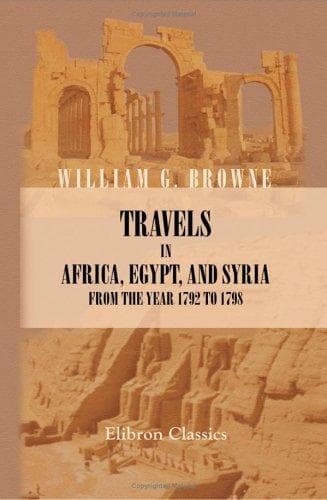
Travels in Africa, Egypt, and Syria, from the year 1792 to 1798Browne, William George
History
Travels in Africa, Egypt, and Syria, from the year 1792 to 1798
Browne, William George
Egypt -- Description and travel; Sudan -- Description and travel; Syria -- Description and travel
There is a _Gindi_ or officer at Charjé, and another at Beirîs,
both belonging to Ibrahim-bey-el-kebir, to whom those villages
appertain; and to them is entrusted the management of what relates
to the caravan during the time of its stay there. We left Charjé
on Friday the 7th of June, and having passed another desert space,
after six hours reached another village, called Bulak. This is a
wretchedly poor place, the houses being only small square pieces of
ground inclosed with a wall of clay, or unburned bricks, and generally
without a roof. It furnishes good water, and the people live by the
sale of their dates. The caravan remained a day at Bulak, and having
left it on Sunday the 9th, arrived at Beirîs on Monday the 10th,
after nearly fourteen hours march through a barren tract. Here the
Chabir thought proper to go through the same ceremony as at Charjé.
On the 13th we employed two hours in passing from Beirîs to Mughess,
the last village of the Oasis toward the Southern desert. We left
Mughess on the morning of the 15th, and on Thursday the 20th,
in the morning, arrived at Sheb. At this place, by digging to the
depth of a few feet in the sand, is found a supply of indifferent
water. A tribe of the wandering Arabs, called _Ababde_, who come
from the neighbourhood of the Nile, sometimes infests it. Sheb
is marked by the production of a great quantity of native alum,
as the name imports. The surface, near which the alum is found,
abounds with a reddish stone; and in many places is seen argillaceous
earth. Having left Sheb on the 21st, we arrived at Selimé on the
23d. This is a small verdant spot, at the foot of a ridge of rocks of
no great height, nor apparently extending very far. It affords the
best water of any place on the route; but though there be verdure
enough to relieve the eye from the dry sterility of the surrounding
surface, it affords no vegetable fit for the support either of man
or beast. At Selime is a small building, which has apparently been
raised by some of the tribes resting there, that place being much
frequented by the roving parties passing the desert in different
directions. The building consists only of loose stones, but the
jelabs related many fables concerning it; as that it had of old
been inhabited by a princess who, like the Amazons, drew the bow,
and wielded the battle-axe, with her own hand; that she was attended
by a large number of followers, who spread terror all over Nubia,
&c.; and that her name was Selimé[33].
Public-domain text, read in full here on John Shaqi.
Reviews
Reviews
No reviews yet
Be the first to share your thoughts on this work.
Elsewhere in the archive
Join the Discussion
Join the discussion
Sign in to leave a comment or review.
Sign InorCreate an account