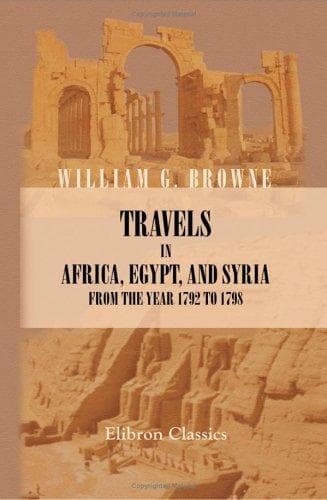
Travels in Africa, Egypt, and Syria, from the year 1792 to 1798Browne, William George
History
Travels in Africa, Egypt, and Syria, from the year 1792 to 1798
Browne, William George
Egypt -- Description and travel; Sudan -- Description and travel; Syria -- Description and travel
VI. _Explanation of the plate facing page 286_ 495
=TRAVELS=
IN
_AFRICA,_
_EGYPT, AND SYRIA._
* * * * *
CHAP. I.
ALEXANDRIA.
_Antient Walls and Ruins — The two Ports — Reservoirs —
Vegetation — Antiquities — Population — Government — Commerce
— Manufactures — Anecdote of recent History._
THE transit from the coasts of Britain to those of Egypt was marked
by nothing that can interest or amuse, unless it be the contrast
between the phenomena of winter on the former, with those which
strike the view on approaching the latter. A sea voyage is always
tedious, except to the merchant and the mariner; and therefore,
though our’s was attended with every favourable circumstance,
and occupied no more than twenty-six days, there is scarcely any
thing relative to it that can afford entertainment in the recital. I
arrived in Egypt on the 10th of January 1792.
Alexandria now exhibits very few marks, by which it could be
recognized as one of the principal monuments of the magnificence
of the conqueror of Asia, the emporium of the east, and the chosen
theatre of the far-sought luxuries of the Roman Triumvir, and the
Egyptian queen. Its decay doubtless has been gradual; but fifteen
centuries, during which it has been progressive, have evinced its
antient opulence by the slowness of its fall.
The present walls are of Saracenic structure, and therefore can
determine nothing with respect to the antient dimensions of the
city[1]. They are lofty, being in some places more than forty
feet in height, and apparently no where so little as twenty. But,
though substantial and flanked with towers, they could offer no
resistance, unless it were against the Mamlûk cavalry, which alone
the inhabitants fear, and accordingly keep them in some repair. They
also furnish a sufficient security against the Bedouins, who live part
of the year on the banks of the canal, and often plunder the cattle
in the neighbourhood. The few flocks and herds, which are destined
to supply the wants of the city, are pastured on the herbage, of
which the vicinity of the canal favours the growth, and generally
brought in at night, when the two gates are shut; as they also are
whenever it is known that hostile tribes are encamped near them.
These Saracenic walls present nothing curious, except some ruinous
towers: and the only remain of the antient city worth notice is
a colonnade, near the gate leading to Rashîd, of which, however,
only a few columns remain; and what is called the amphitheatre on
the south east, a rising ground, whence is a fine view of the city
and port. Of the singular suburb styled Necropolis, or “The City
of the Dead,” no remain exists.
Public-domain text, read in full here on John Shaqi.
Reviews
Reviews
No reviews yet
Be the first to share your thoughts on this work.
Join the Discussion
Join the discussion
Sign in to leave a comment or review.
Sign InorCreate an account