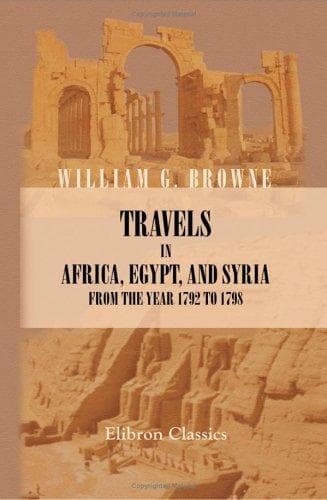
Travels in Africa, Egypt, and Syria, from the year 1792 to 1798Browne, William George
History
Travels in Africa, Egypt, and Syria, from the year 1792 to 1798
Browne, William George
Egypt -- Description and travel; Sudan -- Description and travel; Syria -- Description and travel
The elephant is seen, in the places he frequents, in large herds of
four or five hundred, according to report. It is even said that two
thousand are sometimes found together; but I do not suspect the Arabs
of extreme accuracy in counting. These people hunt him on horseback,
having singled out a straggler from the herd; or aim at him with
spears from the trees; or make pits into which he falls. His hide
is applied to many useful purposes. The African elephant is smaller
than the Asiatic, and probably of a different species. The meat is an
article of food in great esteem with them. The fat forms a valuable
unguent, and the teeth, as is well known, supply the merchants with
immense profits.
The buffaloe is not found tame in Soudân. The wild one is hunted
by the Arabs, and serves them for food. The hippopotamus is killed
for his skin, (which being remarkably tough, makes excellent shields,
and whips not wholly unlike our horse-whips) and for his teeth, which
are much superior to ivory. The horn of the rhinoceros, to which
animal the Arabs have applied a term somewhat less appropriate than
the Greek, but still characteristic, (_Abu-kurn_, father of the one
horn,) makes a valuable article of trade, and is carried to Egypt,
where it is sold at an high price, being used for sabre-hilts,
and various other purposes. The more credulous attribute to it some
efficacy as an antidote against poison.
The antelope and the ostrich are extremely common throughout the
empire. The civet-cat is not seen wild in the quarter which I visited,
but is frequent enough farther to the South. Many are preserved in
cages in the houses of the rich. The women apply the odour extracted
from them to add to their personal allurements; and what is not thus
disposed of becomes an article of trade.
The lion and leopard, though common in a certain district, are not
found near the seat of government. The Arabs hunt them, strip off the
skin, which they sell, and often eat the flesh, which they conceive
generates courage and a warlike disposition. They occasionally take
them young, and bring them for sale to the Jelabs, who sometimes carry
them as presents to the great men in Egypt. I purchased two lions:
the one was only four months old when I bought him. By degrees,
having little else to employ me, I had rendered him so tame, that he
had acquired most of the habits of a dog. He satiated himself twice
a week with the offal of the butchers, and then commonly slept for
several hours successively. When food was given them they both grew
ferocious towards each other, and towards any one who approached
them. Except at that time, though both were males, I never saw them
disagree, nor shew any sign of ferocity towards the human race. Even
lambs passed them unmolested. The largest had grown to the height
of thirty inches and a half over the shoulders.
Public-domain text, read in full here on John Shaqi.
Reviews
Reviews
No reviews yet
Be the first to share your thoughts on this work.
Elsewhere in the archive
Join the Discussion
Join the discussion
Sign in to leave a comment or review.
Sign InorCreate an account