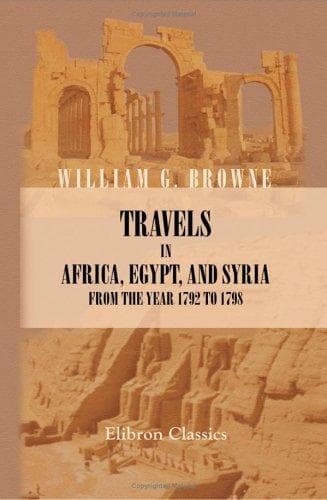
Travels in Africa, Egypt, and Syria, from the year 1792 to 1798Browne, William George
History
Travels in Africa, Egypt, and Syria, from the year 1792 to 1798
Browne, William George
Egypt -- Description and travel; Sudan -- Description and travel; Syria -- Description and travel
Though my residence in Dar-Fûr was so much protracted, I feel myself
able to furnish only a very imperfect catalogue of its vegetable
productions. These are to be sought chiefly in the districts to the
South, where water abounds, and where the extreme restraint under
which I found myself prevented me from seeking them.
During seven or eight months in the year the whole surface of the
earth to the North is dried up by the sun, and the minute plants
which spring and flourish during the _Harîf_[45], are mingled in
the general marcescence, as soon as that season is passed. Even the
trees, whose fibres pierce more deeply into the substance of their
parent soil, lose the distinctive marks of their proper foliage,
and exhibit to the distant observer only the sharp outline of their
grosser ramifications.
Of the trees which shade our forests or adorn our gardens in Europe,
very few exist in Dar-Fûr. The characteristic marks of those species
which most abound there, are their sharp thorns, and the solid and
unperishable quality of their substance. 1. The Tamarind is not very
common in the quarter I frequented; but those which were visible to
me were of great height and bulk, and bore a copious supply of fruit.
2. The Plane, platanus Orientalis, _Deleib_, is found, but seems
rather to have been brought from Egypt, than indigenous.
3. Sycamore of Egypt, _Ficus Sycomorus_, _Gimmeiz_, a few near Cobbé;
said to be much more common to the southward. I did not observe that
it produced any fruit.
4. _Nebbek_ Ar. _Paliurus Athenæi_. Of this there are two species
in Dar-Fûr. They term the largest _Nebbek-el-arab_. There
is a difference in their fruit, as well as in their external
appearance. The one is a bush, with leaves of dark green, not very
different from those of the ivy, but much thinner. It appeared to be
the same I had seen in the gardens of Alexandria. The other a tree,
growing to considerable size, but having both the leaves and fruit
smaller, and the fruit of darker colour, and somewhat different
flavour. Both of them equally thorny. The natives eat the fruit
fresh or dry; for it dries on the tree, and so remains great part
of the winter months. In that state it is formed into a paste of
not unpleasant flavour, and is a portable provision on journies.
Public-domain text, read in full here on John Shaqi.
Reviews
Reviews
No reviews yet
Be the first to share your thoughts on this work.
Elsewhere in the archive
Join the Discussion
Join the discussion
Sign in to leave a comment or review.
Sign InorCreate an account