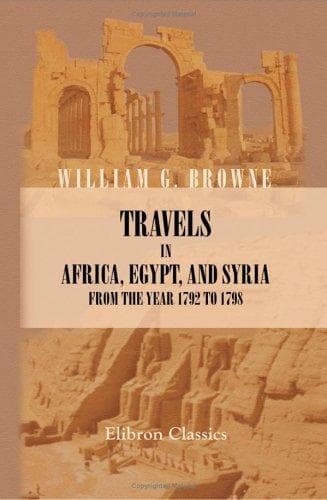
Travels in Africa, Egypt, and Syria, from the year 1792 to 1798Browne, William George
History
Travels in Africa, Egypt, and Syria, from the year 1792 to 1798
Browne, William George
Egypt -- Description and travel; Sudan -- Description and travel; Syria -- Description and travel
5. _Heglîg_ or _Hejlij_, Ar. This tree is about the same size as
the one last mentioned, and is said to be a native of Arabia, though
I have seen it only in Fûr.—The leaf is small, and the fruit it
bears is of an oblong form, about the size of a date. Colour brown,
tinctured with orange; dry, and of a viscous quality. The nucleus
is large in proportion to the fruit, which adheres to it with great
tenacity. This is also formed into a paste, but of no agreeable
flavour. It is however eaten by the Arabs, and by some esteemed
efficacious as a remedy for certain diseases. It seems a slight
diuretic. The wood is hard, and of a yellowish colour; it grows in
great abundance, and is very thorny. This, together with the _Nebbek_,
chiefly furnish thorns for the fences.
6. _Enneb_, a small tree, to the fruit of which they have given the
name of grapes. It bears leaves of light green hue, and the fruit,
which is of a purple colour, is attached, not in bunches, but singly
to the smaller branches, and interspersed among the leaves. The
internal structure of the fruit is not very unlike the grape,
which it also resembles in size. But the pulp is of a red hue,
and the taste is strongly astringent.
7. _Shaw_, Ar. a shrub about the size of the Arbutus, having, like
it, a leaf of strong texture, of oval form, pale green, wider at the
lower, and narrower at the upper extremity than the arbutus.—The
leaf has the pungency and very much the taste of mustard. This shrub I
saw chiefly in _Wadi Shaw_, a place we passed in going and returning,
between Sweini and Bîr-el-malha. The natives cut off the smaller
branches, which they use to rub their teeth, alleging that the acrid
juice of this plant has the property of whitening them.
From an exact correspondence as to the place of its growth,
viz. near the salt springs, the camels not eating it, and some
other circumstances, I take this to be the _Rack_ of Bruce,
vol. v. p. 44. though unable to recognize it in the figure there
given.
8. Ceratonia Siliqua, _Charôb_.
9. Solanum sanctum, nightshade, _Beidinjan_, or _Melingân_, brought
originally from Egypt, and used for food.
10. _El Henne_, from Egypt, growing into use.
11. _Sophar_, Ar. Cassia sophera, wild senna, native, and grows in
plenty after the rains.
12. _Sûnt_, Mimosa Nilotica, in great quantity.—It is from
this tree, which is also called _Seiâl_, that the gum, brought to
Egypt by the caravans, is chiefly gathered. There are also found
the trees called by Bruce _Ergett Dimmo_, and _Ergett-el-Kurûn_,
and the _Farek_, Bauhinia Acuminata of the same writer.
13. A kind of legumen called _Fûl_, bean. It is not much used for
food, but as an ornament by the women, being strung in the form of
beads, when quite dry, at which time it is very hard. It is also
used as a weight of four or five grains.
Public-domain text, read in full here on John Shaqi.
Reviews
Reviews
No reviews yet
Be the first to share your thoughts on this work.
Elsewhere in the archive
Join the Discussion
Join the discussion
Sign in to leave a comment or review.
Sign InorCreate an account