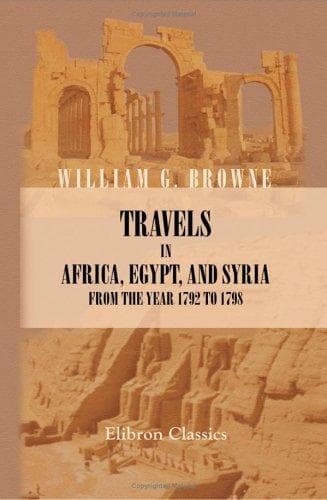
Travels in Africa, Egypt, and Syria, from the year 1792 to 1798Browne, William George
History
Travels in Africa, Egypt, and Syria, from the year 1792 to 1798
Browne, William George
Egypt -- Description and travel; Sudan -- Description and travel; Syria -- Description and travel
The usurper, after the victory, found himself in peaceable possession
of the throne; yet judging it right to maintain for a time the shew of
moderation and self-denial, he employed that dissimulation for which
his countrymen are famous, in persuading them that his affections were
fixed on the blessings of futurity, and that he was indifferent to
the splendour of empire. He refused even to see the treasures of his
deceased brother, in gold, slaves, &c. and as he entered the interior
of the palace drew the folds of his turban over his eyes, saying the
temptation was too great for him, and invocating the Supreme Being
to preserve him from its effects. For a certain time too he confined
himself to the possession of four wives (free women) allowed by
the law of the Prophet. At length, finding his claim unquestioned,
and his authority firmly established, the veil of sanctity, now
no longer necessary, was thrown aside, and ambition and avarice
appeared without disguise. He now wastes whole days in misanthropic
solitude, gazing in stupid admiration on heaps of costly apparel, and
an endless train of slaves and camels, and revels in the submissive
charms of near two hundred free women. Abd-el-rachmân assumed the
Imperial dignity in the year of the Hejira 1202, of the Christian
æra 1787. The discontent of the people however, and particularly
of the soldiery in consequence of the severity of his regulations,
and his personal avarice, were (1795) very much increasing, which
made me imagine his reign would not be long.
_History._
Mohammed Teraub, already mentioned, was preceded by a king named
Abd-el-Casim; Abd-el-Casim by Bokar; Bokar by Omar. Some of the
earlier kings are yet spoken of under the names of Solyman, Mohammed,
&c. But as the people of the country possess no written documents, I
found those of whom I inquired often at variance both with regard to
the genealogy and the succession of their monarchs. In all countries
these are points of small import; but especially in one of which so
few particulars are known to us. It may yet be remarked, that they
commonly mention the reign of Solyman, as the epocha when Islamism
began to prevail in the country. Describing this Sultan, at the
same time, as of the _Dageou_ race, which swayed the sceptre long
before that of Fûr became powerful. Circumstances have inclined me
to believe, that the reign of this prince must have been from one
hundred and thirty to one hundred and fifty years ago.
On what the natives relate of their early history, little dependence
can be placed: but it seems that the _Dageou_ race came originally
from the North, having been expelled from that part of Africa now,
nominally at least, under the dominion of Tunis[46].
_Harvest, food, &c._
Public-domain text, read in full here on John Shaqi.
Reviews
Reviews
No reviews yet
Be the first to share your thoughts on this work.
Elsewhere in the archive
Join the Discussion
Join the discussion
Sign in to leave a comment or review.
Sign InorCreate an account