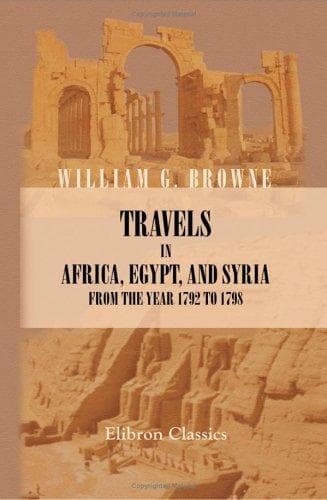
Travels in Africa, Egypt, and Syria, from the year 1792 to 1798Browne, William George
History
Travels in Africa, Egypt, and Syria, from the year 1792 to 1798
Browne, William George
Egypt -- Description and travel; Sudan -- Description and travel; Syria -- Description and travel
In that part of the country where I resided are found neither lakes,
rivers, marshes, nor any other appearance of water but the wells
which are dug for domestic consumption, except during the rainy
season. At that period torrents, of greater or less dimensions,
intersect the country in all directions. The rainy season lasts from
before the middle of June to the middle or end of September. This
season is called Harîf[47].
I have observed that the rain, which is generally very heavy and
accompanied with lightning, falls most frequently from 3 P.M. till
midnight.
The changes of the wind are not periodical but instantaneous. It is
with a southerly wind that the greatest heat prevails; and with a
South-East that the greatest quantity of rain falls. When the breeze
is from the North or North-west it is most refreshing, but does not
generally continue long in that quarter. The hot and oppressive winds
which fill the air with thick dust blow constantly from the South.
One day, while I was sitting in the market-place at Cobbé, I observed
a singular appearance in the air, which soon discovered itself to
be a column of sand, raised from the desert by a whirlwind. It was
apparently about a mile and a half distant, and continued about eight
minutes; this phenomenon had nothing of the tremendous appearance
of the columns of sand described by Bruce as rising between Assuân
and Chendi, being merely a light cloud of sand.
The harvest is conducted in a very simple manner. The women and
slaves of the proprietor are employed to break off the ears with
their hands, leaving the straw standing, which is afterwards applied
to buildings and various other useful purposes. They then accumulate
them in baskets, and carry them away on their heads. When threshed,
which is awkwardly and incompletely performed, they expose the grain
to the sun till it become quite dry; after this an hole in the earth
is prepared, the bottom and sides of which are covered with chaff
to exclude the vermin. This cavity or magazine is filled with grain,
which is then covered with chaff, and afterwards with earth. In this
way the maize is preserved tolerably well. In using it for food,
they grind it, and boil it in the form of polenta, which is eaten
either with fresh or sour milk, or still more frequently with a
sauce made of dried meat pounded in a mortar, and boiled with onions,
&c. The Furians use little butter; with the Egyptians and Arabs it
is an article in great request. There is also another sauce which
the poorer people use and highly relish, it is composed of an herb
called _Cowel_ or _Cawel_, of a taste in part acescent and in part
bitter, and generally disagreeable to strangers.
Public-domain text, read in full here on John Shaqi.
Reviews
Reviews
No reviews yet
Be the first to share your thoughts on this work.
Elsewhere in the archive
Join the Discussion
Join the discussion
Sign in to leave a comment or review.
Sign InorCreate an account