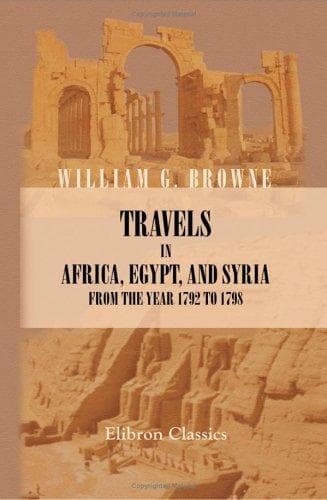
Travels in Africa, Egypt, and Syria, from the year 1792 to 1798Browne, William George
History
Travels in Africa, Egypt, and Syria, from the year 1792 to 1798
Browne, William George
Egypt -- Description and travel; Sudan -- Description and travel; Syria -- Description and travel
The population consists of Mohammedans of various nations; Greeks
in considerable number, who have a church and convent, containing
only three or four religious, but agreeably situated on the highest
ground among the gardens; Armenians, who have also a church; and a few
Jews, who have their synagogue. The whole, perhaps, may not amount
to less than twenty thousand souls[3]; which, however, the length
of my residence there did not enable me to decide. The Franciscans
of Terra Santa have a church and monastery, in which reside three
or four of their order. The habitations of the European consuls and
merchants are all near together, east of the city and close to the
sea. They associate with each other, dress and live as in Europe, and,
unless by their mutual animosities, are perfectly undisturbed. It is
true, indeed, that the natives bear no very good character for their
behaviour to strangers, but, I believe, when incivility has been
experienced, it has generally first been provoked: and the natives
are, perhaps, at least as often the dupes of the Frank merchants,
as the latter are of the native brokers and factors, whom their
commercial concerns oblige them to employ. The command of the fort,
and of the few troops which are in the city, is vested in a Sardar,
who is sometimes a Cashef, sometimes an inferior officer of the
Beys. The internal government is in the hands of the citizens. The
chief magistrate is the Cadi, an Arab, who receives his appointment
from Constantinople; the others are, the Shechs of the four sects,
and the Imâms of the two principal mosques. Here it may be observed,
once for all, that the municipal magistrates in the east are always
of the sacerdotal order.
The revenues of Alexandria, under the Ptolemies, are stated at
12,500 talents, which at 193l. 15s. the talent, is little less than
two millions and an half sterling. At this time it is thought that
they do not exceed four thousand five hundred purses, or 225,000l.
The commerce of Alexandria is more considerable than that of
Damiatt. All exports to Europe, or imports from thence, are made at
the former. The whole of the timber for house or ship building is
brought from Candia, or the Archipelago. The copper, manufactured or
rough, of which the consumption is large, from Constantinople. Coffee
and rice, raw leather, &c. are exported to that and other places. The
transit of all these keeps the inhabitants in that state of activity
to which they are eminently disposed; and if various causes operate
unavoidably to fetter and stagnate commerce, it cannot be said that
they are in fault. The navigation from Alexandria to Rashîd is
conducted in small vessels of from fifteen to fifty tons burthen,
which deposit their goods at Rashîd, whence they are embarked in
boats of another form, and conveyed to Kahira.
Public-domain text, read in full here on John Shaqi.
Reviews
Reviews
No reviews yet
Be the first to share your thoughts on this work.
Join the Discussion
Join the discussion
Sign in to leave a comment or review.
Sign InorCreate an account