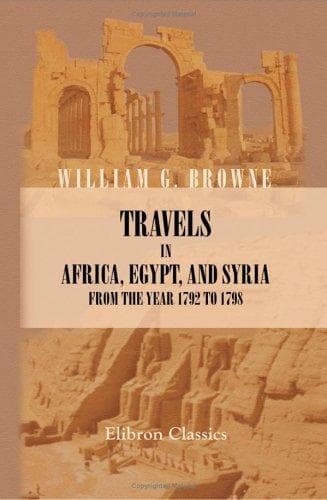
Travels in Africa, Egypt, and Syria, from the year 1792 to 1798Browne, William George
History
Travels in Africa, Egypt, and Syria, from the year 1792 to 1798
Browne, William George
Egypt -- Description and travel; Sudan -- Description and travel; Syria -- Description and travel
The adjacent country in general is fertile in vines and mulberry
trees, though rather mountainous. Naplosa has several mosques,
and carries on a considerable traffic with Damascus and the coast:
there is also a cotton manufacture. Jews abound of the Samaritan
heresy; but the inhabitants are very hostile to Christians, who
have no establishments here. The town is in fact governed by the
chief inhabitants, though a nominal deputy be appointed by the Pasha
of Damascus.
On my journey from Naplosa to Nazareth, during the first part of
the route, which was rocky and mountainous, I observed only three
villages in the space of as many hours; but the vales are full of
olives, fig trees, and vines, and even the rocks are shaded with a
variety of verdure. Having passed the mountains of Naplosa, (_Ebal_
and _Gerizim_,) we came to an extensive plain of excellent land, which
however after rain is almost inundated. Near its northern extremity
is seated a small fortress, which repulsed Jezzar Pasha at the head
of five thousand men, and some pieces of artillery: it displays
seven or eight small round towers, and has two gates. The peasants
of Samaria are hardy and warlike, and generally go well armed.
Sebasté or Samaria is now a miserable deserted village. Ginæa is
a decent town, half way between Naplosa and Nazareth. The latter
is a pleasant village, seated on an easy slope, with a respectable
convent: most of the inhabitants are Christians. While I was there,
the Samaritans had made an inroad, and carried off some cattle: the
Nazareens armed themselves, and made reprisals of seventeen oxen. In
the neighbourhood is Mount Tabor, whence there is a delightful
prospect, and which is noted for the absurd doctrines it gave name
to in the ecclesiastical disputes of the Greek empire.
CHAP. XXIII.
GALILEE — ACCA.
_Improvements by Jezzar — Trade — Taxes — White promontory,
and river Leontes — Tyre — Seide — Earthquake — Kesrawan
— Syrian wines — Beirût — Anchorage — Provisions — River
Adonis — Antûra — Harrîsé — Tripoli — Ladakia — Journey
to Aleppo or Haleb._
Galilee is here divided from Samaria by a ridge of hills. Six hours
were employed in passing from Nazareth to Acré, by the Arabs
more properly termed _Acca_. At a village on the route observed
a sarcophage, now used for watering cattle, and some scattered
fragments of columns. But few villages appear between Nazareth and
Acré, though the land be fertile.
Acré is fortified with a wall of very moderate strength, having
only one gate. It is a pretty large town, but many of the houses are
empty: yet the population may be estimated between fifteen and twenty
thousand. There remains part of a double fosse, which extended round
the town, but is daily dilapidated for modern erections. There is
no castle nor other relique of antiquity.
Public-domain text, read in full here on John Shaqi.
Reviews
Reviews
No reviews yet
Be the first to share your thoughts on this work.
Elsewhere in the archive
Join the Discussion
Join the discussion
Sign in to leave a comment or review.
Sign InorCreate an account