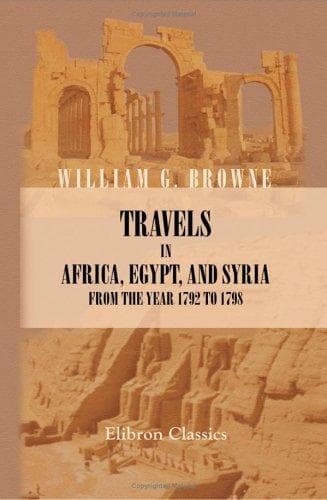
Travels in Africa, Egypt, and Syria, from the year 1792 to 1798Browne, William George
History
Travels in Africa, Egypt, and Syria, from the year 1792 to 1798
Browne, William George
Egypt -- Description and travel; Sudan -- Description and travel; Syria -- Description and travel
On the fifth day arrived at _Keftîn_, a village remarkable for its
pigeon-houses, which supply the adjacent country, even to Aleppo. The
neighbouring lands abound in wheat and barley, sown in ridges; the
soil is rich, and requires no farrow. The women here go unveiled,
and at _Martrawân_, which is not far removed, are by their friends
presented to strangers.
The people are termed _Ansarîé_ in Arabic, a sect of pretended
Mohammedans, who are said to worship the pudendum muliebre. With
Christians they affect to be of their faith. The women are fair,
have black eyes, and tolerable features. The strange practice above
commemorated, seems a relique of the antient dissolute manners of
Antioch and Daphne.
Thence to Aleppo is a journey of eight hours; for two hours through
corn lands, the rest passes a barren country. That city is visible
at the distance of two hours, and as you approach displays a most
magnificent appearance.
CHAP. XXIV.
OBSERVATIONS AT ALEPPO.
_Sherîfs and Janizaries — Manufactures and commerce — Quarries
— Price of provisions — New sect — Journey to Antioch —
Description of antient Seleucia — Return to Aleppo._
The country adjacent to Aleppo is broken with many inequalities,
and even the city stands partly on high and partly on low ground. A
small river, called _Coik_, descends from _Aintab_, and, after
passing through the city, is lost in a marsh on the West.
So many descriptions of this famous capital having appeared, I
shall only offer a few remarks on such objects as struck me during
my residence there.
The site is rocky, and the few gardens chiefly produce pistachios. The
city is well built, and paved with stone. The tall cyprus trees,
contrasted with the white minarets of numerous mosques, give it a
most picturesque appearance. The population and buildings seem to
be on the increase; but this affords no proof of public felicity;
for, in proportion as the capital swells, the adjacent villages are
deserted. The houses are clean, airy, substantial, and commodious. The
people in general are distinguished by an air of affected polish,
hardly to be observed in the other towns of Syria. Their dialect
too has its characteristic marks. The Arabic prevails, though many
speak the Turkish language.
Public-domain text, read in full here on John Shaqi.
Reviews
Reviews
No reviews yet
Be the first to share your thoughts on this work.
Elsewhere in the archive
Join the Discussion
Join the discussion
Sign in to leave a comment or review.
Sign InorCreate an account