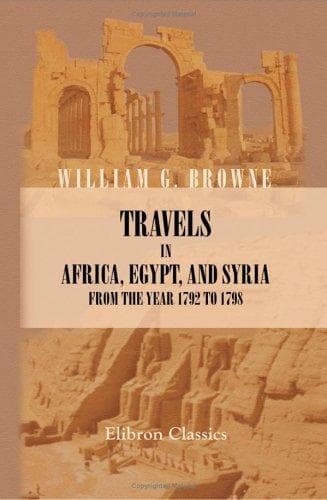
Travels in Africa, Egypt, and Syria, from the year 1792 to 1798Browne, William George
History
Travels in Africa, Egypt, and Syria, from the year 1792 to 1798
Browne, William George
Egypt -- Description and travel; Sudan -- Description and travel; Syria -- Description and travel
A new Pasha had been lately appointed at the time I arrived, but was
prevented from entering the city, by the feuds which had prevailed
between the Sherîfs and the Janizaries, and induced the latter to
suspect that the Pasha had a design of punishing them. This officer
was a young man, the son of the Pasha of Adene; his title El Sherîf
Mohammed Pasha; of an unblemished character, but unequal, in point
of talents and personal weight, to compose the violence of these
factions, which, after he had resided a short time in the city,
obliged him to retire. The Sherîfs, or descendants of Mohammed,
here form a considerable faction; a circumstance also observable
at Bagdad, but not in so remarkable a degree. In Aleppo they form a
body of near sixty thousand. The Janizaries do not exceed one-fourth
of that number. The Sherîfs consist of all ranks, from the highest
Imâm to the lowest peasant, and are far from excelling in courage:
the Janizaries are of superior valour, though little acquainted with
the use of arms or aspect of battle. Hence the force of the factions
is merely balanced, and continual disputes arise for offices of
profit or power, which generally terminate in bloodshed. In the
course of this summer, 1797, several of these took place; in one
of them it is supposed near three hundred persons perished. This
imperfect exercise of authority may be estimated among the symptoms
of decline in the Turkish empire.
The manufactures are in a flourishing state, being carried on with
great spirit both by Christians and Mohammedans: silk and cotton form
the chief articles. Large caravans frequently arrive from Bagdad and
Bassora, charged with coffee, which is carried round to the Persian
gulf from Moccha, with the tobacco and cherry-tree pipes from Persia,
and muslins, shawls, and other products of India.
Besides the manufactures of Aleppo, and the productions of the
surrounding country, which are sent to Europe by sea, three or four
caravans, laden with merchandize, proceed annually through Anatolia
to Constantinople. Pistachio nuts form no mean article of trade,
being the chief produce of the adjacent territory, in the soil
of which that tree particularly delights. Aleppo also maintains a
commercial intercourse with Damascus, Antioch, Tripoli, Ladakia,
and the towns on the East towards the Euphrates.
The last pestilence is supposed to have destroyed sixty thousand of
the inhabitants.
The women of Aleppo are rather masculine, of brown complexions,
and remarkable for indulging in the Sapphic affection.
Public-domain text, read in full here on John Shaqi.
Reviews
Reviews
No reviews yet
Be the first to share your thoughts on this work.
Elsewhere in the archive
Join the Discussion
Join the discussion
Sign in to leave a comment or review.
Sign InorCreate an account