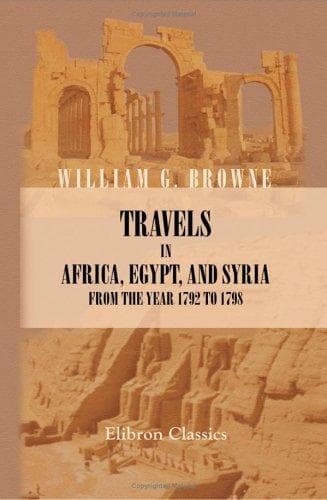
Travels in Africa, Egypt, and Syria, from the year 1792 to 1798Browne, William George
History
Travels in Africa, Egypt, and Syria, from the year 1792 to 1798
Browne, William George
Egypt -- Description and travel; Sudan -- Description and travel; Syria -- Description and travel
There are several kinds of preserved meat prepared among the orientals
for long journies. They obviate the inconveniency of salt provision
by using clarified butter. The kind most used is called _mishli_,
and will keep good for many years. It is brought from Western Barbary
to Kahira.
In the places where we generally rested are found the jerboa,
the tortoise, the lizard, and some serpents, but not in great
number. There is also an immense quantity of snails attached to the
thorny plants on which the camels feed. These the Arabs frequently
eat. Very few birds were visible in this quarter, except of the
marine kind. One of our party killed a small hawk, which was
the only one I saw. Near the few springs of water are found wild
rabbits, which in Arabic they distinguish by the same name as the
hare, (ارنب) and the track of the antelope and the ostrich are
frequently discoverable. We passed no day without being incommoded
with frequent showers; and generally a cold wind from north-west and
north-west by north. Several small parties of Bedouins, who were
feeding a few goats, sheep, and asses, were encamped in the road,
and in the vicinity of the lake Mareotis, now dry. Such of them as
were the friends of our conductor received us with every mark of
hospitality and kindness; and regaled us with milk, dates, and bread
newly baked. One party, indeed, became contentious for a present,
or tribute on passing; but being in no condition to enforce their
demand, it was after a time relinquished.
On Sunday the 4th, having travelled about six hours, we came to
a well where was a copious supply of water; and having given the
camels time to drink, we left the coast, and proceeded in a south-west
direction. From Alexandria to this well, the time employed in motion
was seventy-five hours and an half, or nearly so. Thence to Siwa,
there being little or no water, we were obliged to use all possible
diligence in the route. Our arrival there happened on Friday the 9th,
at eight in the evening. The space of time we were actually travelling
from the coast, was sixty two hours and a quarter. The road from the
shore inward to Siwa is perfectly barren, consisting wholly of rocks
and sand, among which talc is found in great abundance. On Wednesday
the 7th, at night, we had reached a small village called قارة
ام الصغير Karet-am-el Sogheir: it is a miserable place, the buildings
being chiefly of clay; and the people remarkably poor and dirty. It
afforded the seasonable relief of fresh water, a small quantity of
mutton, (for the Shech el Bellad was kind enough to kill a sheep, in
return for some trifling presents which were made him,) and wood to
dress pilau, from which we had been obliged to abstain since leaving
the coast. This village is independent, and its environs afford nothing
but dates, in which even the camels and asses of this quarter are
accustomed to find their nourishment.
Public-domain text, read in full here on John Shaqi.
Reviews
Reviews
No reviews yet
Be the first to share your thoughts on this work.
Join the Discussion
Join the discussion
Sign in to leave a comment or review.
Sign InorCreate an account