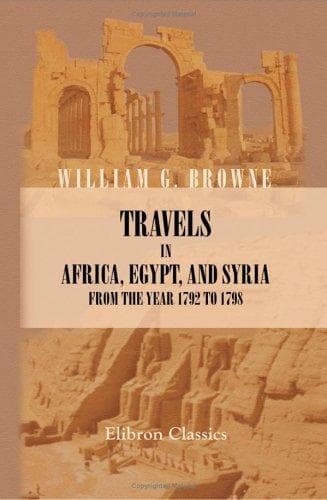
Travels in Africa, Egypt, and Syria, from the year 1792 to 1798Browne, William George
History
Travels in Africa, Egypt, and Syria, from the year 1792 to 1798
Browne, William George
Egypt -- Description and travel; Sudan -- Description and travel; Syria -- Description and travel
The whole expense of the sacred caravan from Damascus to Mecca
used formerly to amount to four thousand five hundred purses,
and an increase has since taken place. The Pasha carries with him,
exclusively of this, one thousand purses for his own use. Jezzâr was
accustomed to take two thousand for the purpose of buying coffee,
which he resold to vast advantage. The 4500 purses are deducted
from the imperial treasury (_chosné_), and the Pasha is rendered
accountable for the safety of the caravan. He receives the Senjiak
Sherîfî, or Ensign of the Prophet, from the governor of the castle,
giving an acknowlegement in writing, before witnesses, in which he
solemnly pledges himself to bring it back. Similar forms are observed
on restoring it to its place. As soon as the Pasha arrives near the
city on his return, a messenger is dispatched to Constantinople,
who is obliged to perform the journey in twenty-five days. He
carries water from the famous well Zem-zem, near Mecca, and some
dates from Mediné, which are presented to the Emperor on his visit
to the mosque. After this, the Wizîr presents a list of the Pashas
for the ensuing year; the Sultan reads it, and if he object to any
name, affixes to it a mark, after which the firmâns are made out
in due form.
CHAP. XXVI.
_Journey from Damascus to Balbec — Syriac language — Balbec —
Recent discoveries — Zahhlé — Printing-office — Houses of
Damascus — Return to Aleppo._
On Thursday the sixteenth of August 1797, set out from Damascus for
Balbec or Heliopolis, attended only by the owner of the mule I rode
on. Arrived at the convent of _Seidnaia_, which commands a fair view
of the city of Damascus, and the plain. Vines and fig-trees adorn the
country through which I travelled. The wine has less flavour and body
than that of Kasrawân, but is esteemed more grateful to the stomach.
From _Seidnaia_ I proceeded to _Malûla_, a village situated
in the mountain, where is a convent, said to be of the time of
Justinian. Thence went to _Yebrûd_, the antient _Jabruda_, a place
higher up the mountain, in a romantic situation; the inhabitants are
chiefly Mohammedans. I met there a Greek bishop, who was going to a
place near Balbec, an intelligent and curious man. We proceeded in
company till we came to Balbec.
Soon after arrived at _Mara_, a small town on the North of the
road. It is remarked that at this town and at _Malûla_ alone the
Syriac still continues to be a living language; descending from
father to son, without the use of books. Two of the muleteers I
observed to converse together more willingly in that language,
than in the Arabic, which in sound it nearly resembles.
Public-domain text, read in full here on John Shaqi.
Reviews
Reviews
No reviews yet
Be the first to share your thoughts on this work.
Elsewhere in the archive
Join the Discussion
Join the discussion
Sign in to leave a comment or review.
Sign InorCreate an account