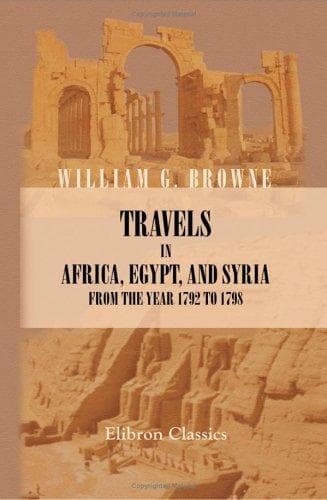
Travels in Africa, Egypt, and Syria, from the year 1792 to 1798Browne, William George
History
Travels in Africa, Egypt, and Syria, from the year 1792 to 1798
Browne, William George
Egypt -- Description and travel; Sudan -- Description and travel; Syria -- Description and travel
After a journey of two days, through a rugged route along the
ridge of the mountain, arrived at the convent of St. John, where
the printing-office is. Paper being dear, and no demand for books,
the press is stopped. Arabic books alone were edited.
On my return by _Zibdané_ observed there a gate of Grecian
architecture. Passed through a rich vale, watered by the _Baradé_,
formerly the Chrysorrhoas, to Damascus.
So numerous are the fruit-trees in the vicinity of this city,
that those which die and are cut down, supply it with abundant
fire-wood. They are also used for building, together with the
walnut-tree and Lombardy poplar. The houses in Damascus are
remarkably large and commodious, and well supplied with water;
of many the furniture is worth from one to five hundred purses,
or from five thousand to twenty-five thousand pounds, in divans or
large sophas, of the richest silk, embroidered with pearl, Persian
carpets, mirrors, &c.
The _melingana_, a species of the solanum, is consumed here in
such quantities as a common vegetable, that fifty hundred weight is
estimated the daily supply of the city.
Returned from Damascus to Aleppo, 7th October 1797, a journey of
twelve days. Almost every town or village on the route has its market,
so that there is no occasion to prepare provisions; the caravanserais
are in a ruinous situation.
On visiting the castle of Aleppo, observed a remarkable fact
considering the populousness of the city. There were only eighteen
prisoners, eight of whom were confined for debt, and the remainder
on account of the riot between the Janizaries and Sherîfs. The
debtor is not permitted, in the whole Turkish empire, to be confined
above one month; during which term, according to the Mohammedan
doctors, his property must appear, if he have any, and if none,
they consider it unjust to detain him. But this mild regulation is
sometimes frustrated; for if a claim lie for four thousand piasters,
for example, the creditor may first proceed against him for five
hundred, and bring a fresh charge at the end of every month till
the whole be paid, or till the debtor have remained in prison one
month on every distinct process.
CHAP. XXVII.
_Journey from Aleppo towards Constantinople — Route — Aintâb
— Mount Taurus — Bostan — Inhabitants, their manners and dress
— Kaisarîa — Angora — Walls and antiquities — Angora goats
— Manufactures — Topography — Journey to Ismît — Topography
— General remarks concerning Anatolia or Asia Minor._
On the 21st of October 1797, set out from Aleppo on my journey through
Anatolia to Constantinople. I had a horse for myself, and another
for an Armenian servant; seventy mules carried the merchandize of
the caravan.
The direct road lies by Beilan and Adene, Konia, Kutahia, and
Bursa, but _Kutchûk Ali_, the Pasha of Beilan, being in a state
of rebellion, we were constrained to turn to the North-east by an
unusual route, through the cities of Aintab, Kaisarîa, and Angora.
Public-domain text, read in full here on John Shaqi.
Reviews
Reviews
No reviews yet
Be the first to share your thoughts on this work.
Elsewhere in the archive
Join the Discussion
Join the discussion
Sign in to leave a comment or review.
Sign InorCreate an account