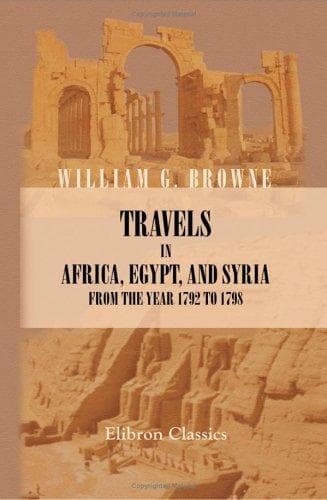
Travels in Africa, Egypt, and Syria, from the year 1792 to 1798Browne, William George
History
Travels in Africa, Egypt, and Syria, from the year 1792 to 1798
Browne, William George
Egypt -- Description and travel; Sudan -- Description and travel; Syria -- Description and travel
English edit. Vol. I. p. 216. Volney says, that when there are
no ships at Suez, that town has no other inhabitants than the
Mamlûk governor, and a garrison, consisting of twelve or fourteen
persons.—In Suez are twelve or thirteen mosques, which could never
have been designed for a garrison of so few persons. There are also
several coffee-houses. In truth the inhabitants are not numerous,
but there are four or five considerable merchants constantly residing
there, who have their correspondents at Kahira, and in the towns of
Arabia, and conduct the commerce between Egypt and India. There is
consequently a proportionate number of their dependents, and persons
who manage commercial affairs of a less considerable kind. There
are ship-builders, and several other artificers; a large khan or
okal where merchandize is lodged; some Greek Christians constantly
residing there; Mohammedan ecclesiastics, and others; and a number of
fishermen and people more immediately connected with the sea. The
population is restrained by the difficulty of procuring water,
scarcity of provisions, and other inconveniences; but invariably
much exceeding the estimate here given.
P. 263. Volney remarks, that the horizon is every where flat,
even in the Upper Egypt, and refers for a proof of his assertion to
Norden’s Plates, which demonstrate precisely the reverse. The fact
is true indeed as to Lower Egypt, but from Kahira upward to Assûan
there is only a very small space where the view is not terminated
by the mountains, of various aspects, on each side.
=No. V.=
_Some remarks on the account of Egypt, contained in the recent
correspondence of the French officers who accompanied Buonaparte
to that country. The work referred to is intitled_, PARIS, PENDANT
L’ANNEE 1798. _Par_ PELTIER. _Vols._ xix. _and_ xx.
Vol. 19, page 455. The distance from Cairo to the cataract is about
360 Geog. miles. The Nile is never an impetuous torrent, nor does it
ever overflow its banks in the whole course from Assûan to Kahira,
but is admitted at proper times into the transverse channels prepared
for it.
P. 457. The Arabs, it is evident, would not build walls of much
greater extent than the habitations they proposed to defend. A
very small part of these being now filled, shews that the decay the
city has undergone since the Turks became possessed of it, has even
been greater than what it sustained from the time of Severus to the
Saracenic conquests.
P. 459. Old Kahira is not Fostat, but Misr el attîké, further South.
_Lettre de Boyer._
P. 475. I doubt whether any one of the towers about Alexandria would
contain 700 men.
Public-domain text, read in full here on John Shaqi.
Reviews
Reviews
No reviews yet
Be the first to share your thoughts on this work.
Elsewhere in the archive
Join the Discussion
Join the discussion
Sign in to leave a comment or review.
Sign InorCreate an account