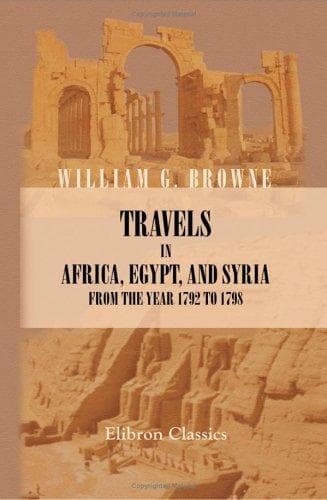
Travels in Africa, Egypt, and Syria, from the year 1792 to 1798Browne, William George
History
Travels in Africa, Egypt, and Syria, from the year 1792 to 1798
Browne, William George
Egypt -- Description and travel; Sudan -- Description and travel; Syria -- Description and travel
[Footnote 3: There happened a plague in 1796, which it is said
carried off one half of the inhabitants. This estimate is possibly
exaggerated; but no doubt it thinned them much; so that at present
they cannot be near so numerous.]
[Footnote 4: Hirtius, Bell. Alex. prope init.]
[Footnote 5: The miles spoken of are always geographical.]
[Footnote 6: See Major Rennel’s map.]
[Footnote 7: D’Anville with equal probability supposes Siwa to
be Mareotis.]
[Footnote 8: The water in the river between Terané and Kahira was so
shallow, that with a very small boat (Canjia) we had great difficulty
in passing.]
[Footnote 9: The condition of slave is so very distinct in Egypt from
what it is in other countries, that they who defend the practice of
trading in human flesh by its antiquity, and the general consent
of nations, should be well aware how they adduce the example of
Egypt.—In Kahira, when a slave is legally purchased in the market,
if after any length of time he feel discontented with his master,
has only to say, “Carry me to the market,” (Sûk-es Sultân,)
and the master is legally compellable to offer him for sale.
It can never be believed, that where a power so absolute as that of
the proprietor over his slave, is supported by the sanctions of law,
that no abuses of it should exist; but this single privilege greatly
softens its asperity.
The child of a female slave, begotten by her master, is ipso
facto free, and a slave may authorize a free person to purchase
his emancipation.]
[Footnote 10: The Mamlûks suffer not the beard to grow till they
be emancipated, and hold some office, as Cashef, &c.—A similar
practice obtains among the Osmanli. The Ytch oghlans, though free in
their persons, yet exercising a kind of servitude, shave the beard:
so that though it be not absolutely the mark of a slave, the want of
a beard seems to denote a dependent situation. Among the Osmanli,
(European Turks) the beard is allowed to grow rather in conformity
to the precept and practice of the Prophet, than as a national
fashion. The Tatars wear no beard; and the Arabs alone shew great
respect to that ornament.]
[Footnote 11: The two last offices are annual.]
[Footnote 12: The patacke may be rated at from three shillings to
three and four-pence. The foddân is a given measure, taking its
name from the quantity that a yoke of oxen can plough in a day,
roughly taken, equivalent to an acre.]
[Footnote 13: English edit. p. 188.]
[Footnote 14: The length may be estimated at about three thousand
five hundred yards.]
[Footnote 15: The city is still infested with the usual herds of
dogs, and the kites still shriek wildly over the canal; while the
turtle-doves, unmolested by men or children, breed in the houses,
building their nests under the projecting beams.]
Public-domain text, read in full here on John Shaqi.
Reviews
Reviews
No reviews yet
Be the first to share your thoughts on this work.
Elsewhere in the archive
Join the Discussion
Join the discussion
Sign in to leave a comment or review.
Sign InorCreate an account