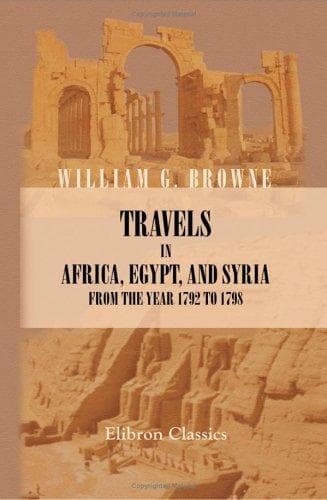
Travels in Africa, Egypt, and Syria, from the year 1792 to 1798Browne, William George
History
Travels in Africa, Egypt, and Syria, from the year 1792 to 1798
Browne, William George
Egypt -- Description and travel; Sudan -- Description and travel; Syria -- Description and travel
The yet numerous population, the various nations with their several
languages, dresses, and manners, conspire with the romantic fame
of _Grand Cairo_, the second capital of the East, the metropolis of
Africa, the scene of surprising events in history, and of yet more
surprising incidents in Arabian fable, to impress the spectator with
curiosity and admiration.
The city Kahira (مصر القهره) is situated on the East of the
Nile, which devolves its majestic flood at some little distance. The
suburbs, however, Misr el attiké, and Bulak, or the port, form two
points of contact with the river. To the South-East and East is a
ridge of the extensive chain which runs along the course of the Nile
to Upper Egypt, sometimes receding, and leaving a plain of about a
league broad, at other places opposing its barrier to the stream. To
the North a plain extends to the Delta, which it resembles in soil
and productions. Immediately under the mountain is the castle, now
incapable of defence, though esteemed of great strength, before the
invention of artillery.
To an eye accustomed to the cities of Europe, their wide streets,
and general uniformity, the view of the capital of Egypt might appear
mean and disgusting. Yet it is termed by the natives “Misr without
an equal, Misr the mother of the world.” Convenience is comparative,
and ideas of it must vary with manners and customs. The narrowness
of the streets appears even necessary to a native, to protect him
from the fierce effulgence of the meridian sun: a slight canopy,
extended from house to house, affords him more pleasure than any
architectural prospect could convey.
For about the space of three hundred years Egypt had been governed
by the military aristocracy of the Mamlûks, when it was subdued by
Sultan Selim, in the year 1517. Sensible of the distance, defended
situation, and refractory spirit of the province, he thought it
politic to enter into a compromise with its former government and
antient prejudices. It was likewise well known, that the secure
situation of the country, little exposed to any external attack,
would have favoured the ambitious designs of a rival Pasha.
By an institution still observed in some instances, he ordained, that
the Pasha should be contented to share the power of the Beys, and
that the duration of his authority should depend on their collective
will. The Beys must necessarily have separate personal interests,
which sometimes lead them to intestine outrage and bloodshed; yet,
with regard to any external power or influence, their interests are
universally the same. As allies or as enemies they form one body and
one soul. Selim was too confident in the power and splendour of the
Ottoman arms, and in his own character of chief of their religion,
to entertain any suspicion that the commands of the Porte would ever
be treated except with distinguished respect.
Public-domain text, read in full here on John Shaqi.
Reviews
Reviews
No reviews yet
Be the first to share your thoughts on this work.
Join the Discussion
Join the discussion
Sign in to leave a comment or review.
Sign InorCreate an account