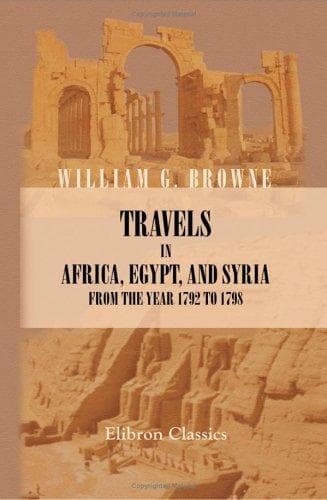
Travels in Africa, Egypt, and Syria, from the year 1792 to 1798Browne, William George
History
Travels in Africa, Egypt, and Syria, from the year 1792 to 1798
Browne, William George
Egypt -- Description and travel; Sudan -- Description and travel; Syria -- Description and travel
Convenient markets appear in every part of the city. Coffee-houses
are equally numerous, where the natives pass a great part of the
day smoking and conversing. These commonly consist of one apartment,
not very large. Only coffee and fire for the pipe are furnished. But
at Damascus I afterwards saw coffee-houses remarkably large, some
of them placed over running water. The furniture is however very
simple, and unlike the splendid apartments, for the same purposes,
to be seen in Constantinople. One, in particular, at Damascus, under
the castle wall, is capable at a very moderate calculation of holding
one thousand persons: it has no walls, but an extensive roof spreads
over numerous benches, and it is encircled with trees and water.
The number of small imposts in Egypt is almost inconceivable; they are
estimated to amount to three hundred and sixty. One is for all goods
crossing from Jiza to Kahira; a poor woman bringing a basket of eggs,
worth two paras, must pay the fifth part of a para for passing. Upon
the whole, the revenue can hardly be raised to a greater amount than
it is.
In May 1792 there was a famine, occasioned by various accidental
circumstances; and wheat sold at 20 and 22 patackes the _ardeb_. In
October 1796 it was at five patackes. When I made my inquiries at
the latter period, the following prices of provisions were stated:
Mutton, per rotal, 10 paras.
Beef, ditto, 8 ditto.
Sugar, per rotal, 20 to 25 paras.
Sweet oil, ditto, 12 ditto.
Milk, ditto, 4 ditto.
Tobacco of Ladakîa, per oke, 45 to 70 paras.
Fowls, small, 12 paras each.
The recent history of Egypt, till the time of Ismaîl Bey, is
sufficiently known. On the death of Ismaîl, Hassan Bey succeeded him
in his office of Shech-el-bellad, governor of the city, and implying
the precedence among the Beys. Hassan was soon expelled by Murad Bey,
who held the office till the Capitan Pasha arrived from Constantinople
with a fleet, and drove him into Upper Egypt. The Pasha, after
satisfying his avarice, withdrew, and the Beys returned. Ibrahim Bey,
who had been a slave of Ali Bey the Great, had however acquired such
authority, that Murad was constrained to share the government with
him; and they have since ruled Egypt, Ibrahim as _Shech-el-bellad_,
and Murad as _Defter-dâr_. Mutual jealousies prevail between them,
each seeking the destruction of the other. They however conspire
together to recruit the number of the Mamlûks, and to collect
treasure from all quarters.
These are considered as usurpers by the Beys of Upper Egypt, who are
favoured by the Porte; one of whom, named Ali, contrived to escape
from Saïd into Syria, where he courted the nearest Pasha, Jezzâr
of Akka, to support their interest; but that potent and able leader
refused to listen to his suggestions, or amused him with false hopes.
Public-domain text, read in full here on John Shaqi.
Reviews
Reviews
No reviews yet
Be the first to share your thoughts on this work.
Elsewhere in the archive
Join the Discussion
Join the discussion
Sign in to leave a comment or review.
Sign InorCreate an account