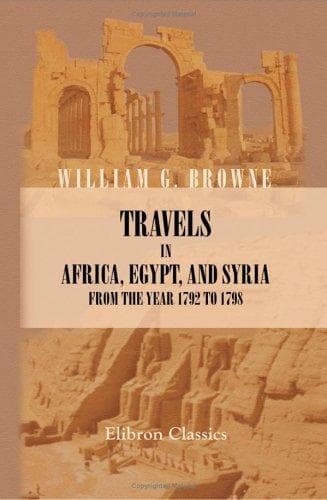
Travels in Africa, Egypt, and Syria, from the year 1792 to 1798Browne, William George
History
Travels in Africa, Egypt, and Syria, from the year 1792 to 1798
Browne, William George
Egypt -- Description and travel; Sudan -- Description and travel; Syria -- Description and travel
28th Oct. Near a village called Hillal, observed reliques of an
antient town; part of two small Egyptian temples, and a statue of
less than the human size, in a kneeling posture, but broken off
above the knees; the feet and legs remaining entire. The place has
been surrounded by a thick wall of unburned brick, but of what date
it is now impossible to determine.
The following day, a little shower fell in the morning; the only
instance I met with of rain in Upper Egypt. Arrived at Edfû, and
inspected a gate or portico, and a small Egyptian temple adjoining.
30th. Passed by _Gebel-el-Silsili_, the chained mountain, where,
in antient times, a chain was passed across the Nile. Here are some
sculptures in the rock, which is of hard free-stone, not of granite,
as Norden mentions by mistake.
Same day sailed by _Kûm-Ombû_, literally the heap or ruins of
Ombos. Saw there the temple described by the traveller just mentioned.
On the following day arrived at _Assuân_, the antient Syene. The
remains of antiquity are here few, and some seem rather of Roman
than Egyptian fabric. Even the modern town is almost in ruins, and
contains very few houses and inhabitants; it is chiefly supported by
a small duty upon dates, passing from Ibrîm to Kahira. Near Assûan
may be still seen the tombs of the Mamlûks who fled from Selim on
his invasion of Egypt. They are now very ruinous.
Some remains of antiquity are yet visible in the isle opposite Syene,
antiently called Elephantine[25]. The Arabs use one as an inclosure
for cattle. A statue of granite also appears, holding a lituus in
each hand. It is remarkable that many of the present inhabitants of
this island have the negro countenance, hair, and person.
About three hours walk from Assûan is the _cataract_, in Ar. _Shelal_,
more properly _rapides_, being merely an easy descent of the river among
numerous isles and rocks of granite, which obstruct the current. Far from
deafening the spectator, the noise is hardly audible.
Near the cataract I observed some black rocks; but whether of
basaltes, or any other substance, the distance prevented me from
distinguishing. It is well known that many of the antient statues
and engraved stones found in Egypt are of that material, but it is
believed to have been drawn from Abyssinia. I observed no quarries of
basaltes either in Egypt or the other parts of Africa which I visited.
At Assûan I remained three days, contriving, if possible, to pursue
my route up the Nile. But a war having arisen between the Mamlûks
of Upper Egypt and the Cashef of Ibrîm, no one was suffered to pass
from Egypt to Nubia. The caravans had all been stopped for many
months, and not even a camel could be procured. At Kahira I could
attain no previous knowlege of this war having originated with the
fugitive Beys.
With deep regret for the disappointment in my earnest wish of
proceeding to Abyssinia by this route, I was constrained to abandon
all hope for that season, and to think of returning.
Public-domain text, read in full here on John Shaqi.
Reviews
Reviews
No reviews yet
Be the first to share your thoughts on this work.
Elsewhere in the archive
Join the Discussion
Join the discussion
Sign in to leave a comment or review.
Sign InorCreate an account