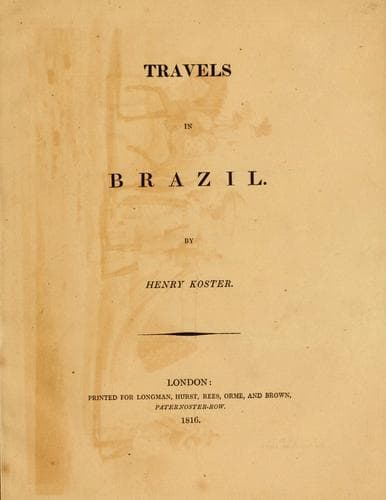
Brazil -- Description and travel; Slavery -- Brazil
others nearly naked, and all of them half starved with cold and hunger.
The vessel had sprung a leak, which increased so rapidly, as to oblige
them to retreat from the deck into the foretop, where they had been for
three days and two nights, almost destitute of provisions.
We arrived safe off Falmouth on the 20th of May. Here the supercargo
and myself landed, and proceeded to London.
CHAPTER X.
THE AUTHOR SETS SAIL FROM GRAVESEND AND ARRIVES AT PERNAMBUCO.—STATE
OF RECIFE.—JOURNEY TO BOM JARDIM WITH A CAPITAM-MOR, AND RETURN TO
RECIFE.
AT the commencement of the winter my friends again recommended a
return to a more temperate climate than that of England; and therefore
understanding that the Portugueze ship Serra Pequeno was upon the point
of sailing, I took my passage in her. She was lying at Gravesend, and
on the 4th October, 1811, I embarked again for Pernambuco.
Contrary winds detained the ship at Portsmouth for about six weeks. On
the 20th November, the wind came round to the northward and eastward,
and the signal guns from the ships of war, appointed as convoys,
awakened us. All was bustle and confusion at Cowes, where great numbers
of persons, belonging to the ships, who were circumstanced as we were,
had stationed themselves. In a few hours the vessels were under weigh,
and before the night closed in, all of them had cleared the Needles.
The Serra Pequeno and other Portugueze ships had taken instructions
from a frigate, which was bound to the Mediterranean, intending to keep
company with her as far as her destination and their’s obliged them to
follow the same course; but in the morning we discovered that we were
with another frigate, which was bound to Lisbon. We soon left her, and
were accompanied by other two Portugueze ships. On the night of the
22d, we fell in with the Kangaroo sloop of war, which was bound to the
coast of Africa, with a few vessels under convoy. On the 24th we parted
from this convoy, and on the 26th proceeded with only one Portugueze
ship. Our passage was most prosperous; we had no boisterous weather,
and few calms. On the 3d December, we fell in with the Arethusa
frigate, when in sight of the Canary islands. The captain of the Serra
was obliged to take the papers of his ship on board the frigate. The
regulations regarding the slave trade, which is carried on by the
Portugueze, perhaps occasioned more enquiry than would otherwise have
been deemed necessary. We crossed the line on the 22d. In the evening
of the 26th we stood for the land, supposing that we had reached the
latitude of our port, but that we were much to the eastward of it;
however, we made the land about two o’clock in the morning, which
was sooner by several hours than the officers of the ship imagined
we should. This frequently occurs on board of those vessels which do
not carry chronometers; the calculation of longitude without their
assistance being of course rendered extremely liable to error. At
Public-domain text, read in full here on John Shaqi.
Reviews
Reviews
No reviews yet
Be the first to share your thoughts on this work.
Elsewhere in the archive
Join the Discussion
Join the discussion
Sign in to leave a comment or review.
Sign InorCreate an account