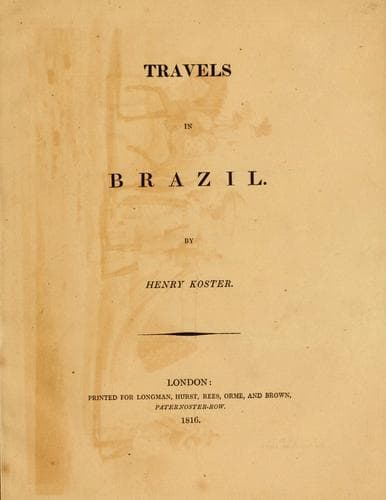
Brazil -- Description and travel; Slavery -- Brazil
RICE is very little cultivated in Pernambuco; but at Maranham it
forms the second object of trade. The use of it in Pernambuco is
inconsiderable, from the idea that it is unwholesome for the negroes;
and indeed I never met with any of the Africans who preferred it to
other kinds of food.
COFFEE and CACAO are yet planted as experiments, for their introduction
into Pernambuco is recent.[189]
IPECACUANHA.—Although this is at present only to be found in a wild
state, I have inserted it here, for it must shortly take its place
among cultivated plants. The small quantity exported is procured by the
Indians and other persons of the same rank and habits of life, in the
thickest woods. It thrives most in the shade. The plant is destroyed
also by many of the larger kinds of game, to which it serves as food.
There are two species of it which are distinguished by the names of
white and black Ipecacuanha; the latter is that which is used for
medicinal purposes in Europe[190]. The white is used by the Brazilians
in colds and coughs, and is taken to purify the blood after a fever.
GINGER is indigenous, but is now rarely to be found in a wild
state[191]. The white ginger is that which is in general use.
MALAGUETA PEPPER is a small shrub which is to be seen under the eaves
of almost every cottage. The pods are of a bright scarlet colour, of
about one inch in length, and one quarter in breadth. It is a hardy
plant; for although it droops under excessive drought, it is seldom
destroyed by it. Often are to be seen at the same time, and upon the
same bush, the blossoms, and the green and the ripe scarlet pods.
Wherever this shrub springs up care is taken of it; for the people of
all ranks are from habit almost unable to eat their food without the
_malagueta_. The pods are bruised when about to be used, and either
form an ingredient in every dish, or they are served up in all the
sauces[192]. The _pimenta de cheiro_, or scented pepper, is likewise
common, but it requires more care in rearing, and is a smaller shrub
than the _malagueta_. The pods are of a bright red in general, but
sometimes they are, naturally, of a pale yellow colour; they are round,
and about the size of a crab apple.
TEA is stated to be indigenous in Brazil[193]. A priest of
considerable reputation as a botanist, told me that he had discovered
this plant in the neighbourhood of Olinda; but afterwards again he
informed me that he was afraid he had been too sanguine.[194]
Public-domain text, read in full here on John Shaqi.
Reviews
Reviews
No reviews yet
Be the first to share your thoughts on this work.
Elsewhere in the archive
Join the Discussion
Join the discussion
Sign in to leave a comment or review.
Sign InorCreate an account