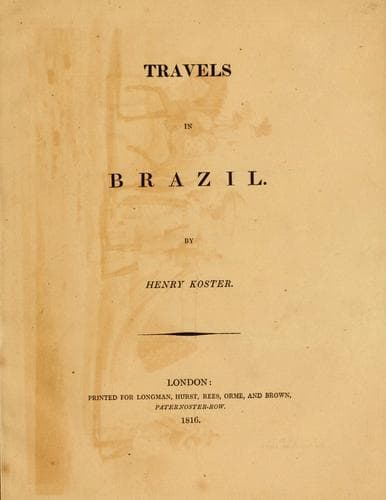
Brazil -- Description and travel; Slavery -- Brazil
HORTICULTURE has of late years been rapidly improving, and the markets
of Recife are now well supplied with vegetables and roots. The
gardeners are chiefly Portugueze, from the provinces of the mother
country, or from the Azores. Peas[195], cabbages, and several other
kinds of European vegetables and roots are to be purchased, besides
others which are peculiar to the country, such as _mandubims_ and yams.
The European onion produces a small root of an oblong form[196], which
is known in Pernambuco under the name of _cebolinho_, as the diminutive
of _cebola_, an onion. The vine is to be seen in many of the gardens
in the neighbourhood of Recife and of Olinda; and formerly there were
a great many at Conception upon the island of Itamaraca, but few now
remain. No wine is made. The fruit trees are some of those which are
common to the southern parts of Europe, such as the orange[197], the
fig, and others, but no olives; besides these, there are the manga,
the jack, and a numerous list, some of which have been mentioned
incidentally in the course of this volume; but I have tarried already
too long upon this branch of my subject, and must now proceed to
something else.
[Illustration: _A Planter and his Wife on a Journey._]
CHAPTER XVIII.
THE FREE POPULATION.
THE insufficiency of the population of Portugal to the almost unbounded
plans of the rulers of that kingdom, has, in all probability, saved
her South American possessions from the dreadful contests which are
to be apprehended in the neighbouring Spanish colonies, between the
Creole white inhabitants and those of colour. The struggle yet rages
with exterminating violence between the descendants of Europeans, born
in South America, and the natives of Old Spain; but when this is at
an end, another equally, if not more destructive, is to be looked for
between the former and their countrymen of mixed casts. The appeal
which the creole whites have made to the people, and the declarations
which they have publicly set forth, of directing their proceedings by
their voice; the exposure of those abstract principles of government
which are so delightful in theory, but so difficult of execution,
will, most probably, bring down upon their heads the destruction which
has thus been courted. In the Portugueze South American dominions,
circumstances have directed that there should be no division of
casts, and very few of those degrading and most galling distinctions
which have been made by all other nations in the management of their
colonies. That this was not intended by the mother country, but was
rather submitted to from necessity, is to be discovered in some few
regulations, which plainly shew, that if Portugal could have preserved
the superiority of the whites, she would, as well as her neighbours,
have established laws for this purpose. The rulers of Portugal wished
to colonize to an unlimited extent; but their country did not possess
a population sufficiently numerous for their magnificent plans.
Public-domain text, read in full here on John Shaqi.
Reviews
Reviews
No reviews yet
Be the first to share your thoughts on this work.
Elsewhere in the archive
Join the Discussion
Join the discussion
Sign in to leave a comment or review.
Sign InorCreate an account