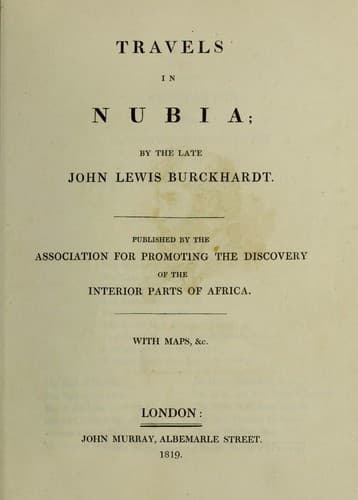
Burckhardt, John Lewis, 1784-1817; Nile River Valley -- Description and travel; Nubia -- Description and travel
One hour and three quarters from Fereyg, I rejoined my guide,
at the foot of an insulated hill, close to the water, on which
a castle has been built, resembling in size and form, that at
Ibrim; it bears the name of Kalat Adde (قلعت ادّه); it
has been abandoned many years, being entirely surrounded by barren
rocks. Part of its ancient wall, similar in construction to that
of Ibrim, still remains. The habitations are built partly of stone
and partly of bricks. On the most elevated spot in the small town,
eight or ten gray granite columns of small dimensions lie on the
ground, with a few capitals of red sand-stone near them, of clumsy
Greek architecture. The rock of this hill is a fine pudding-stone,
of flint, quartz, and red sand-stone; the only specimen of the kind I
have met with in Nubia. Opposite the castle, the river forms a large
island, called Beyllany (جزيرة بيلاني), from the name of
the village nearest to it, on the western side. The mountain round
Adde is composed of rugged hills of grotesque shape, which seem to
have been shattered by some violent commotion of nature. From hence,
upwards, the course of the river is W. S. W. Two hours and a half
from Fereyg, the eastern mountain branches out far to the eastward,
and closes with the river again beyond the second Cataract of Wady
Halfa. The wild shrub, Oshour (عشور), called by the Arabs of the
Dead Sea, Asheyr (عشير), grows here in great quantity. This plant
produces a fruit, within which is a bunch of silky fibres enveloping
a small bean. It has been described by Norden. It grows in every
part of Upper Egypt, south of Siout, in sandy spots near the river;
but is not so large there as it is in Nubia; the Egyptians call it
Fetme (فتمه). From Silsilis (south of Edfou) to the district
of Mahass, it is the most common weed met with on the road: its
leaves are poisonous to the camels. The Coloquintida (حَنضَل)
is likewise frequently met with, where the Oshour grows. Like the
Arabian Bedouins, the Nubians make tinder of it.[28] At the end
of three hours we passed, in the sandy plain, a number of tumuli,
or barrows, of various sizes, covered with sand: I counted about
twenty-five within the circuit of a mile and a half: the regularity
of their shape, which is exactly the same as that of the tumuli in
the Syrian deserts, and the plain of Troy, makes it almost certain,
that they are artificial. Three hours and a half, Kosko, a small
village. Four hours, the large village of Endhana, also called
Adhendhan (انضانا—اضنضان). In riding along, we were
invited to a funeral feast by the inhabitants of a house belonging
to some relation of the Nubian princes; the possessor had died a
few days before at Derr, and on receiving the news of his death,
his relations here had slaughtered a cow, with which they were
entertaining the whole neighbourhood; at two hours distance from
the village, I met women with plates upon their heads, who had been
receiving their share of the meat. Cows are killed only by people
Public-domain text, read in full here on John Shaqi.
Reviews
Reviews
No reviews yet
Be the first to share your thoughts on this work.
Elsewhere in the archive
Join the Discussion
Join the discussion
Sign in to leave a comment or review.
Sign InorCreate an account