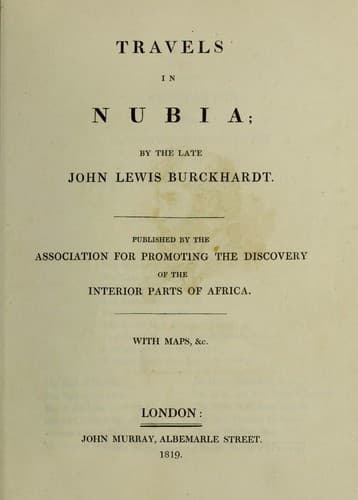
Burckhardt, John Lewis, 1784-1817; Nile River Valley -- Description and travel; Nubia -- Description and travel
of consequence, on the death of a near relation; the common people
content themselves with a sheep or a goat, the flesh of which is
equally distributed; the poorer class distribute some bread only
at the grave of the deceased. Four hours and three quarters; upon
the hill, at the south end of Wady Endhana, opposite the village
of Faras, on the west side of the river, stands an ancient ruined
mosque. Five hours and a half, passed the fine island of Faras. The
country is here open, but the plain, on both sides of the river, is
covered with sand. Seven hours, the village Serra gharby (سرّه
غربي) on the west side. Seven and a half, the ruins of a small
Arab town close to the water, enclosed by a thick brick wall. Eight
hours, Serra (سرّه), a fine village; eight and a half, Debeyra
(دبَيرهَ), where I slept. My guide always conducted me to the
house of the principal person in the village; we should otherwise
have often gone supperless to rest. Wherever we alighted, a mat was
spread for us upon the ground, just before the gate of the house,
which strangers are never permitted to enter, unless they are
intimate acquaintance. Dhourra bread, with milk, was our usual
supper; to this were sometimes added dates. The landlord never
eats with his guests, except when earnestly pressed to do so. Our
camels were not always fed by our hosts, who excused themselves, by
saying that the stock of Dhourra stalks was already exhausted. If
the stranger is to be well treated, a breakfast is brought in,
at sunrise, before he departs; it consists of hot milk and bread,
the supper being usually cold: but we were seldom so fortunate as to
get a breakfast, and generally rode the whole day without tasting
any thing but a few dates from our own stock, at some spot where
we stopped in the morning to bait our camels upon the tamarisk or
acacia trees.
_March 6th._ Our road lay over a fertile plain, covered with date
trees and habitations, to Eshke (اشقه). The Nile had been so
very low last year, that the plain had not been inundated. An old
man, a relation of the governors of Nubia, on seeing me pass by his
house, invited me to stop, and entertained me most hospitably. He
had been, in his youth, governor of Sukkot, where he had acted
with great tyranny; but he seemed to have repented of his former
deeds, and was now become the benefactor of Eshke. A handful of
burnt coffee, which I gave him, was a most acceptable present,
and he insisted upon my staying with him one day, promising that
he would cause a lamb to be killed for me; but this did not appear
to me a sufficient temptation to retard my journey.
Public-domain text, read in full here on John Shaqi.
Reviews
Reviews
No reviews yet
Be the first to share your thoughts on this work.
Elsewhere in the archive
Join the Discussion
Join the discussion
Sign in to leave a comment or review.
Sign InorCreate an account