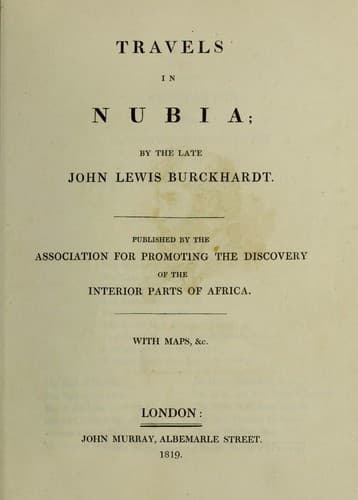
Burckhardt, John Lewis, 1784-1817; Nile River Valley -- Description and travel; Nubia -- Description and travel
In the plain of Aamara are the ruins of a fine Egyptian temple:
the shafts of six large columns of the pronaos remain, constructed
of calcareous stone, and they are the only specimen of that kind I
have seen, all the Egyptian temples being built of sand-stone. The
sculptures upon these columns are in imitation of those of Philæ,
and are of middling execution; but much better than those of the
temple at Derr: the figure of the ibis most frequently occurs: over
each compartment or group of figures is a square blank tablet, as if
to receive an inscription; the same thing is seen at Dakke, Kalabshe,
and Philæ; but not in the more northern Egyptian temples. All the
capitals of the columns are wanting. Of the cella nothing remains
but mounds of rubbish, except the lowest part of the walls, and
their foundations, which are of stone, reposing upon a substructure
of bricks burnt in the sun: the walls were probably built of
alternate layers of stone and brick. A thick enclosure of brick
surrounds the site of the temple, at about fifty yards distance
from the columns. The temple appears to have been erected at the
period when Egyptian architecture began to degenerate; the finest
specimens are found at Philæ and Dakke.
From Aamara a wide plain opens: the eastern chain making a wide
circuit, while, to the west, the mountains terminate. The cultivable
soil on the east side is nearly one mile and a half in breadth;
and between it and the mountains is a barren tract covered with
small flints and pebbles, similar to that at Suez. Here the river
has many windings. In seven hours we came to Ebar (اَِبر),
where we slept, at the house of one of the women of the brother of
Hassan Kashef; for the governors of Nubia have a number of women
dispersed over their dominions, in order that they may find a
comfortable home wherever they stop, in their unceasing journeys
through them. Hosseyn Kashef has about twenty wives, each of whom
has her own separate establishment. In the inner court-yard of the
lady’s house where we stopped was a well, and water-wheel, turned
by cows; by means of which the surrounding fields were irrigated:
similar wheels are every where met with, but this was the only
instance I saw of their being within the walls of a dwelling. During
this day’s march our camels were constantly at a trot.
Public-domain text, read in full here on John Shaqi.
Reviews
Reviews
No reviews yet
Be the first to share your thoughts on this work.
Elsewhere in the archive
Join the Discussion
Join the discussion
Sign in to leave a comment or review.
Sign InorCreate an account