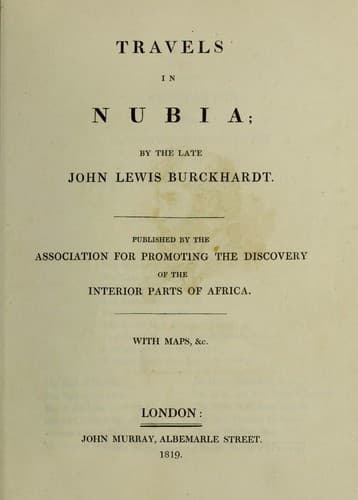
Burckhardt, John Lewis, 1784-1817; Nile River Valley -- Description and travel; Nubia -- Description and travel
Having no particular business with the governor of Ferke, I did not
pay him a visit; but when he saw us riding on, he came gallopping
after us on horseback, with one of his slaves, to enquire who we
were, and insisted upon our returning with him to his house. In cases
like this, compliance is always better than fruitless resistance;
and we therefore crossed over the dry bed of a branch of the river
to the island, where we found the whole neighbourhood assembled at
the governor’s house, to partake of a cow slaughtered in honour
of the same deceased relation, to whose funeral feast we had been
invited at Endhana. The women who were present had a small drum;
and some of them sang glees, in honour of the deceased, while
others danced. Our host had a great desire to possess himself of
my camels, and he would have done it, by giving me two others of no
value instead of them, had it not been for his father’s letter. I
excused my having rode on by saying that I thought his residence
had been farther to the southward. He insisted that we should stay
all the night with him; but as I knew this was only to extort a
present from me, I gave him a large piece of soap, after which he
suffered us to depart. From hence to Say, the route is W. 1 S. In
two hours, we reached Mekrake (مقرقه). Four hours, Kennis
(قِنّس). The plain is cultivated in a few spots only. Senna
mekke grows in quantity, and is of a good quality, though still
inferior to that of the Eastern mountain; it is collected here by the
Arabs Kerrarish, whenever there is any demand for it at Esne.[34]
The western borders of the river are quite sandy and barren. Five
hours, Sheikh Medjdera (شيخ مجدره), a small village built
round the tomb of a saint. Here, as in every other part of Nubia,
the thirsty traveller finds, at short distances, water-jars placed by
the roadside, under a low roof. Every village pays a small monthly
stipend to some person to fill these jars in the morning and again
towards evening. The same custom prevails in Upper Egypt, but on a
larger scale; and there are small carawanserais often found near
the wells,[35] which supply travellers with water. In five hours
and a half, we reached Aamara (عَماره), the extremity of
the territory of Sukkot, to the south of which begins the district
of Say.
Public-domain text, read in full here on John Shaqi.
Reviews
Reviews
No reviews yet
Be the first to share your thoughts on this work.
Elsewhere in the archive
Join the Discussion
Join the discussion
Sign in to leave a comment or review.
Sign InorCreate an account