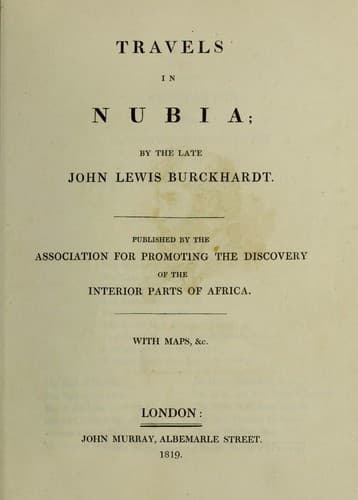
Burckhardt, John Lewis, 1784-1817; Nile River Valley -- Description and travel; Nubia -- Description and travel
The inhabitants of Mahass pretend to be descendants of the Arabs
Koreysh, the tribe to which the prophet Mohammed belonged, and who,
as is well known, were partly Bedouins, and partly husbandmen. It
is the tradition of Mahass, that a large party of Koreysh took
possession of the Wady at the same period when numerous Bedouins
from the East invaded Egypt and Nubia. The chief, or king of Mahass
(ملك الدار) is of the family of Djama (جامع). He collects
the revenue of his kingdom, and pays tribute to the governors of
Nubia, who receive, annually, from each of the six principal places
in his dominions, five or six camels, as many cows, two slaves,
and about forty sheep, besides making extraordinary requisitions. I
had the honour of seeing the king of Mahass, a mean looking black,
attended by half a dozen naked slaves, armed with shields and
lances. From hence, along the Nile to Sennaar, about thirty-five
days journies, there are upwards of twenty kings and kingdoms, every
independent chief being styled Melek. The power of each of these
petty-sovereigns is very arbitrary, as far as relates to exactions
upon the property of his own subjects, but he dares not put any of
them to death, without entailing upon his own family the retaliation
of blood by that of the deceased. All the respectable inhabitants of
Mahass are merchants; they buy slaves in Dóngola, Berber, and in the
country of the Sheygya, and dispatch a caravan to Cairo twice a year;
Mahass is the nearest place, in the Black country, from whence slave
traders arrive at Cairo; the distance is about a thousand miles. A
male slave in Mahass is worth from twenty-five to thirty Spanish
dollars, a female, from thirty to forty. At Cairo they sell at a
profit of one hundred and fifty per cent.; and the merchandize taken
in return produces from two to three hundred per cent., or even
more under the present circumstances, as the Mamelouks are eager
purchasers. Dollars are the currency in concerns of great amount;
but in trifling bargains, the medium of exchange is the measure
of Dhourra, before mentioned,[37] and the pike of linen cloth,
of which shirts are made; thirty pike make a piece, which is worth
one dollar; at Siout its value is two piastres, or two-sevenths of
a dollar. The Nubians, from Derr to Dóngola, have no commercial
intercourse with Darfour, or Bournou. An Arab told me, in Mahass,
that Bournou was from twenty-five to thirty days journies distant
from thence, but that there was scarcely any water on the road.
Public-domain text, read in full here on John Shaqi.
Reviews
Reviews
No reviews yet
Be the first to share your thoughts on this work.
Elsewhere in the archive
Join the Discussion
Join the discussion
Sign in to leave a comment or review.
Sign InorCreate an account