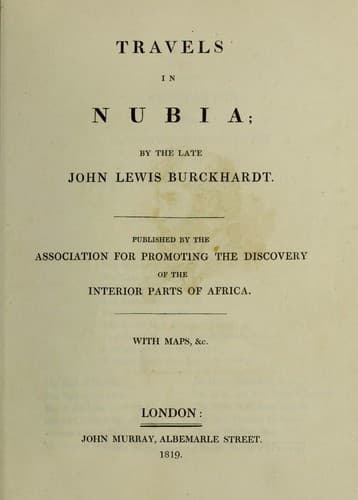
Burckhardt, John Lewis, 1784-1817; Nile River Valley -- Description and travel; Nubia -- Description and travel
The Wady Mahass extends two days beyond Tinareh; its principal places
to the south are: Delligo, from two to three hours from Tinareh,
on the east side of the river; farther on, Koke (كوكّه), on
the west side: here is the last cataract in the Nile; one day’s
journey from Tinareh, is Naoury (نوري), on the east side; then
Berdje (بِرجه), and Ferreg (فريك) on the west side. Two
days journeys from Tinareh, is Hannek (حنق), where the mountains
which confine the Nile through the Wady Mahass terminate. South of
Hannek, half a day’s journey, an island commences, called Mosho,
with a village of the same name on the west bank; and close to
it is the island of Argo, a long day’s journey in length, and
belonging to Dóngola; there is a brick castle upon it, the only
building of any size south of Mahass. Mosho is the northern limit
of Dóngola. Between Argo and Dóngola, is the village or city of
Handak, which I find laid down on the African maps. The river must
take many considerable turnings in the Wady Mahass, as Mosho may
be reached in one day and a half from Tinareh, by a road which lies
over the mountains. The Jesuit missionaries, if I recollect right,
visited Mosho in their way from Dóngola to the Great Oasis.
The Wady Dóngola, where the Nubian language ceases to be spoken,
extends southward on both sides of Argo, and of the numerous other
islands formed in the river, for five days. South of Hannek, the
immense plains of Dóngola commence; I was credibly informed that
there are no rocks in this district, which, during the period of
the inundation, presents a watery surface of from twelve to fifteen
miles in breadth. Commerce is not so flourishing in Dóngola as
it is in the states to the south of it; merchants being exposed to
many vexations from the kings, as well as from the village chiefs,
who seem to be almost independent of the former. A man’s property
is valued, as in Nubia, by the number of water-wheels he possesses,
and the revenue is collected from them. The Arabs Sheygya, since
they have been in possession of a share of the revenue, take from
the ground irrigated by each wheel, four Mhourys[38] of Dhourra,
two or three sheep, and a linen gown worth two dollars. The native
kings take the same. Dóngola is noted for its breed of horses,
great numbers of which are imported by the people of Mahass; they
are chiefly stallions, the natives seldom riding mares. The breed
is originally from Arabia, and is one of the finest I have seen,
possessing all the superior beauty of the horses of that country,
with greater size and more bone. All those which I have seen had
the four legs white, as high as the knee, and I was told that there
are very few of them without this distinctive mark. Prime stallions
bear a high price, from five to ten slaves being paid for one. These
horses do not thrive in northern climates, not even at Cairo, though
Mohammed Aly has lately sent one as a present to the Grand Signior,
for which he gave 750 Spanish dollars.
Public-domain text, read in full here on John Shaqi.
Reviews
Reviews
No reviews yet
Be the first to share your thoughts on this work.
Elsewhere in the archive
Join the Discussion
Join the discussion
Sign in to leave a comment or review.
Sign InorCreate an account