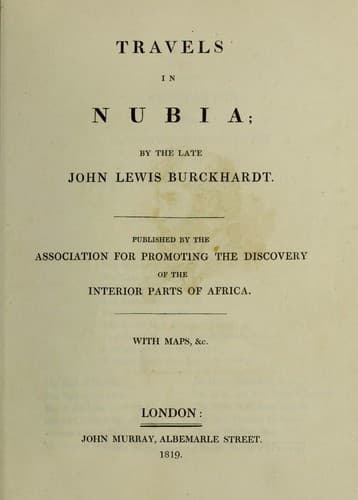
Burckhardt, John Lewis, 1784-1817; Nile River Valley -- Description and travel; Nubia -- Description and travel
The greater part of them are
fed for ten months in the year merely on straw, and in the spring,
upon the green crops of barley. The Mamelouks, since their irruption
into Dóngola, are all mounted upon these horses.
There are no elephants in Dóngola; but the hippopotamus is very
common in the river. Its Arabic name is Barnik (برنيق),
or Farass-el-Bahr (فَرَس البَحر), the Nubians call
it Ird. It is a dreadful plague on account of its voracity,
and the want of means in the inhabitants to destroy it. It often
descends the Nile as far as Sukkot: the peasants, as I passed,
told me that there were three of them in the river between Mahass
and Sukkot. Last year several of them passed the Batn el Hadjar,
and made their appearance at Wady Halfa and Derr, an occurrence
unknown to the oldest inhabitant. One was killed by an Arab, by a
shot over its right eye; the peasants ate the flesh, and the skin[39]
and teeth were sold to a merchant of Siout. Another continued its
course northward, and was seen beyond the cataract at Assouan,
at Derau, one day’s march north of that place.
The city of Dóngola, by the natives called Dóngola el Adjouze
(دُنقله العجوزه), Old Dóngola, or more properly
Tongol (تُنكُل), is equal in size to Derr. The Bedouin
tribe of Kobabish (قبابيش) reside in the country and are
continually making incursions into Darfour, from whence they
carry off slaves. Many individuals of the tribe of Ababde, of
the eastern mountain, were also settled at Dóngola, where they
had acquired great wealth, and influence; but, when the Mamelouks
spread themselves over the country, as will be presently related,
they retired with their chief, Hay (حاي), to Egypt.
Public-domain text, read in full here on John Shaqi.
Reviews
Reviews
No reviews yet
Be the first to share your thoughts on this work.
Elsewhere in the archive
Join the Discussion
Join the discussion
Sign in to leave a comment or review.
Sign InorCreate an account