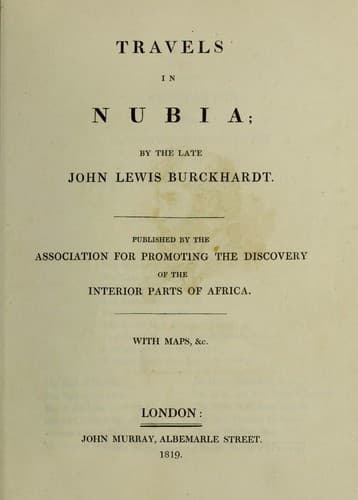
Burckhardt, John Lewis, 1784-1817; Nile River Valley -- Description and travel; Nubia -- Description and travel
In January last, the former made an expedition, with their
whole force, towards Merawe; but, while they proceeded southward,
a party of Sheygya crossed the mountains, and falling on the rear of
the Mamelouks, killed the few followers whom they had left at Argo
and Handak, and plundered what remained of their property. This
was the state of the country, when I was at Tinareh: the Sheygya
were still at Argo, the result of the expedition against Merawe
was then unknown, and the partizans of both sides spread the most
contradictory reports. It was evident, that under such circumstances,
the two Begs whom I saw at Derr could not rejoin their companions;
it was supposed that they would wait the result of the contest,
in the castle of Hannek, in Mahass, which is a strong place.[44]
It appears to me that, in the present state of their affairs,
the Mamelouks have only one alternative; either to strike a last
desperate blow upon Upper Egypt, if the slightest opportunity should
present itself, though the vigilance of Mohammed Aly leaves them
little chance of success in that quarter; or, to endeavour to seize
upon some harbour in the Red Sea, where they may recruit their
strength by the importation of young Georgian slaves, no others
being admitted among them. Massuah is the best situation for such
a project; it is distant from their present position, twenty-two
days; four days across the desert to Shendy, and eighteen days from
thence to Massuah, for the most part along the cultivated banks of
the Astaboras. I believe that the project of invading Abyssinia
is really entertained by the Mamelouks; were they to attempt it,
and succeed, a new and important branch of trade might be opened
to the East India Company; but woe to the country occupied by these
tyrannical and unprincipled slaves! At present, they have no money
left, but they have plenty of slaves with them, with which they can
purchase any thing; a slave being a kind of currency in the southern
countries. Many of the Mamelouks died last summer from the effects
of a putrid fever, which regularly prevails in Dóngola during
the hot season, and carries off numbers of the inhabitants. Unable
to bear the heat in their thick woollen dresses, which they still
continue to wear, they constructed a number of rafts, on board of
which they passed the whole of the summer, under awnings of mats,
kept continually wet by their slaves.
RETURN FROM DAR-EL-MAHASS
TO ASSOUAN.
Public-domain text, read in full here on John Shaqi.
Reviews
Reviews
No reviews yet
Be the first to share your thoughts on this work.
Elsewhere in the archive
Join the Discussion
Join the discussion
Sign in to leave a comment or review.
Sign InorCreate an account