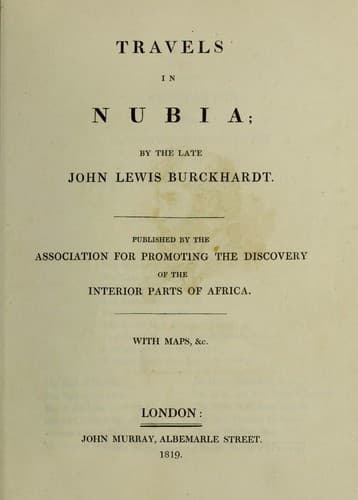
Burckhardt, John Lewis, 1784-1817; Nile River Valley -- Description and travel; Nubia -- Description and travel
_March 15th._ My guide, as it appeared, had received secret
instructions to retard my march. At sunrise, I found him still
asleep, contrary to the custom of the country, which is to rise at
the break of day; and shortly after we had set out, he pretended that
the camel he rode was lame, and unable to proceed at a trot. Seeing
clearly that his intention was to allow Mohammed Kashef’s troops
to come up with us, I told him that he might dismount, as I knew
my way back to Derr perfectly well, and was determined to travel
with all possible haste. On hearing this, he went on, but remained
several times, during the day, at the distance of a mile behind me,
thinking by this means to make me wait for him.
Instead of proceeding across the desert to Waouy, we followed the
river; in one hour and a half, from the place where we slept,
we arrived opposite to Soleb (صُلب), a fine village on the
west bank. There I saw the ruins of a large temple, which it had
been my intention to visit, after crossing the river at Tinareh. I
offered some peasants, who were watering the fields upon an island
opposite Soleb, all the Dhourra remaining in my provision sack,
to carry me over, and back again, which, I think, was as much,
as offering a guinea for a similar service to a London waterman;
but there was no Ramous, nor any of those goat-skins, which when
inflated, often serve as a conveyance on the Nile; and as I did not
think it prudent to trust to my arms only, in swimming over, I was
obliged pursue my route, without gratifying my curiosity. The temple
appeared to have been of the size of the largest of those found in
Egypt; the body of it seemed to be entire, with ten or twelve large
pillars of the pronaos. I hope some other traveller will be more
fortunate than myself, in being able to examine this ruin, which I
believe to be the most southern specimen of Egyptian architecture;
for I was credibly informed that no ancient buildings whatever are
to be found in the southern parts of Mahass, or in Dóngola. It
was, perhaps, a very fortunate circumstance for me, that I did
not cross the river at Tinareh, and proceed down the western bank,
as I should have again fallen in with the two Mamelouk Begs, who
were proceeding rapidly southward on that side, and our meeting in
this part of Nubia might not, perhaps, have been so friendly as it
was when I visited them at Derr.
Public-domain text, read in full here on John Shaqi.
Reviews
Reviews
No reviews yet
Be the first to share your thoughts on this work.
Elsewhere in the archive
Join the Discussion
Join the discussion
Sign in to leave a comment or review.
Sign InorCreate an account