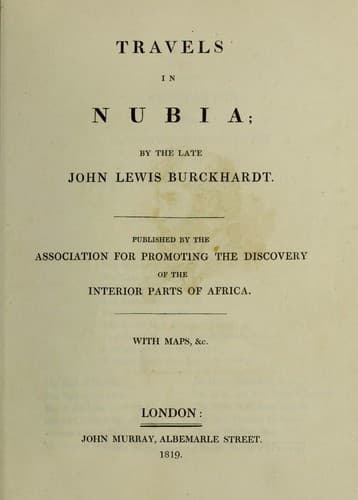
Burckhardt, John Lewis, 1784-1817; Nile River Valley -- Description and travel; Nubia -- Description and travel
The temple is surrounded by ruined brick buildings,
which are certainly of high antiquity; they cover the top of the
hill which overhangs the shore, and are enclosed by a double wall,
or rather by a wall within a parapet; the former is of brick, from
eight to twelve feet thick, and wherever entire, upwards of thirty
feet in height; the parapet is constructed of stone, twenty feet
in breadth, with sides sloping towards the declivity of the hill;
the stones of the parapet are thrown irregularly upon each other,
without cement, but those which form the sloping side are either
cut, or dexterously arranged, so as to present a perfectly smooth
surface, which, at the period when the work was taken care of, must
have rendered it impossible for any one to climb over it. These
works of defence indicate powerful enemies; but who they were, it
is impossible to ascertain. Did the forefathers of the Blemmyes
disturb the hierarchy of Egypt, as their descendants afterwards
did the Roman prætors?
In four hours we arrived opposite the ruins of a brick tower,
or small castle, upon a rocky island: here begins Wady Seras. Our
road was N. E. over ground, covered with deep sand, and perfectly
even, with the exception of a few low insulated hillocks. At five
hours, the plain opens wide to the west, and the river takes a
winding course to the eastward. At the end of seven hours, in an
E. N. E. direction, we came again to the side of the river. In eight
hours and a half, reached the northern extremity of Wady Seras:
an ancient brick castle, called Escot (اسقُط), stands upon
an island. At the end of nine hours, we halted on the high shore,
over the river, opposite a small island, on which was an Arab hut;
we called out to its inhabitants, and one of them swam over to
receive some Dhourra, of which the women made us bread. Doum trees
grow here in plenty, and the fruit had already come to maturity. The
tamarisk and acacia trees also abound.
Public-domain text, read in full here on John Shaqi.
Reviews
Reviews
No reviews yet
Be the first to share your thoughts on this work.
Elsewhere in the archive
Join the Discussion
Join the discussion
Sign in to leave a comment or review.
Sign InorCreate an account