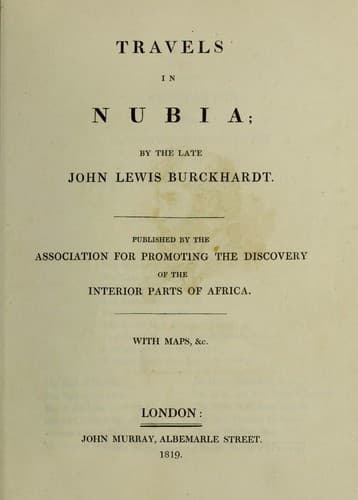
Burckhardt, John Lewis, 1784-1817; Nile River Valley -- Description and travel; Nubia -- Description and travel
_March 19th._ Our path, on setting out, lay along a narrow passage
between rocks of granite, quartz, and feldspath; the direction
north. In one hour and a half we returned to the banks of the river,
near the northern extremity of Wady Attyre, opposite the Akabet
el benat, on the eastern side.[47] Throughout the Batn el Hadjar,
there are a few date trees at intervals on the west bank, but not
so many as on the east; no one claiming a property in these trees,
their fruit is collected by the traveller. We again crossed the
sands from Wady Attyre. In three hours, we reached Wady Samne
(وادي سَمنه), near which is a cataract in the river:
the stream forces its way through a narrow passage, not more than
fifty paces in breadth, formed by two rocks, which project from the
opposite sides. On the east side, upon a hill over the cataract, are
some brick ruins; and, on the west side, are similar ruins, with an
ancient temple on the top of the hill. It is built of sand-stone, and
differs in its shape from other Egyptian temples, though it somewhat
resembles in its plan the small temple of Elephantine. It consists
of a principal building [Illustration] twelve paces in length,
and three paces only in breadth. On each side, stood originally
four small pillars, of which two remain on one side, and three on
the other; one of the former has a polygonal shaft, the others are
square; they are all covered with sculptures. The pillars are joined
to the main building by blocks of stone, which serve as a roof to
the vestibule. There are two small gates. The inner walls of the
apartment are covered with hieroglyphics, and mystic representations
of the divine worship. On both sides a long ship is sculptured,
with Osiris in it; and the group of two figures resting their hands
upon each others shoulders is every where repeated. The roof is
painted blue, and there are some remains of colours upon several of
the figures. Near the posterior wall, opposite the main entrance,
a statue lies on the floor, the head of which has been cut off; it
is about five feet high; the arms are crossed upon the breast, and in
one hand is the flail, and in the other the instrument usually called
a crosier. On the exterior wall of the temple I distinguished several
figures of Mendes, or the Egyptian Priapus. All the sculptures are
of coarse execution; and several of the lines of the compartments
wherein the hieroglyphics are cut, are not straight, as if they had
been the work of young persons only learning their art. Some of the
hieroglyphics on the pillars have evidently been left unfinished;
and even those which are completed, are badly and rudely done. A
part of the wall appears to be of a different date from the rest,
as it is constructed of stones much larger, and better hewn. There
seems to have been another similar building near this temple, for
several capitals of columns are lying on the ground, and a large
block of granite covered with hieroglyphics. All around are heaps
of rubbish.
Public-domain text, read in full here on John Shaqi.
Reviews
Reviews
No reviews yet
Be the first to share your thoughts on this work.
Elsewhere in the archive
Join the Discussion
Join the discussion
Sign in to leave a comment or review.
Sign InorCreate an account