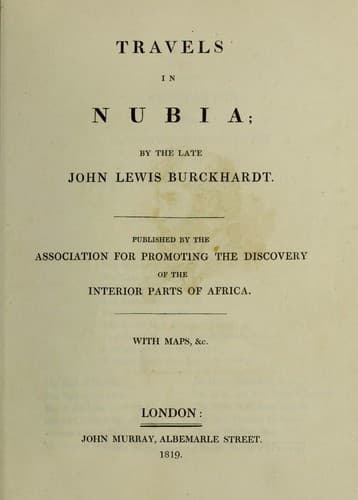
Burckhardt, John Lewis, 1784-1817; Nile River Valley -- Description and travel; Nubia -- Description and travel
At the end of three hours travelling from our setting out in the
morning, we reached Wady Kostamne, situated on both sides of the
river. In five hours, Wady Gyrshe; at the northern extremity of
this village is a temple, cut out of the rock, which presents
a fine contrast to its neighbour at Dakke, having been executed
in the infancy of architectural art, when the artist produced an
imposing effect not by the gracefulness, but the magnitude of his
figures. This temple stands upon the top of a hill, the broad
declivity of which is covered with rubbish and some fragments
of colossal statues. In front, is a portico, consisting of five
square columns on each side, cut out of the rock, with a row of
circular columns in front, constructed of several blocks, and
[Illustration] which originally supported an entablature. Of these
columns only two remain. Before each of the square side columns
stands a colossal statue of sand-stone, about eighteen feet high,
holding a flail in one hand, the other hanging down; they all
represent male figures, with the narrow beard under the chin, and
the high sphinx cap upon the head: their shoulders are covered with
hieroglyphic inscriptions. On both sides of the portico is an open
alley, hewn in the rock, from whence, perhaps, the materials
of the front colonnade were taken. The pronaos, which is entered
from the portico by a large gate, is eighteen paces square, and
contains two rows, three in each, of immense columns, or rather
props, (for they are without capitals,) measuring five feet
by seven in the plan. In front of each of these columns is a
colossal figure, more than twenty feet in height, representing the
usual juvenile character, with the corn-measure or bonnet on the
head, the hands crossed upon the breast, and holding the flail and
crosier. Although these statues are rudely executed, the outlines of
their bodies being less correct even than those of the statues at
Seboua, and their legs mere round blocks, yet they have a striking
effect in this comparatively small apartment; indeed, accustomed
as I had been to the grandeur of Egyptian temples, of which I had
examined so many incomparable specimens, I was nevertheless struck
with admiration on entering this gloomy pronaos, and beholding these
immense figures standing in silence before me. They immediately
recalled to my memory the drawings I had seen of the caves near
Surat, and other Indian excavated temples, which, in many respects,
bear a strong resemblance to those of Nubia. On the side walls
of the pronaos are four recesses, or niches, in each of which
are three statues of the natural size, representing the different
symbolical male and female figures which are seen on the walls of
the temples of Egypt. The centre figures are generally clothed in a
long dress, while the others are naked. All these figures, as well
as the colossi, are covered with a thick coat of stucco, and had
once been painted; they must then have had a splendid appearance. A
Public-domain text, read in full here on John Shaqi.
Reviews
Reviews
No reviews yet
Be the first to share your thoughts on this work.
Elsewhere in the archive
Join the Discussion
Join the discussion
Sign in to leave a comment or review.
Sign InorCreate an account