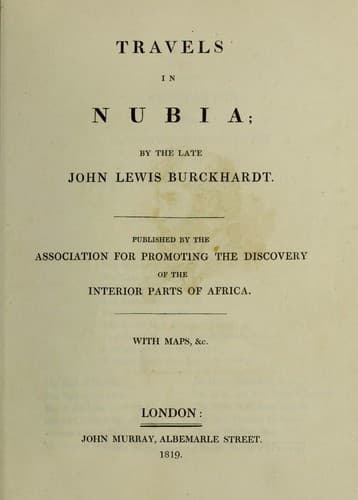
Burckhardt, John Lewis, 1784-1817; Nile River Valley -- Description and travel; Nubia -- Description and travel
The walls of the portico are prolonged the whole length of the
temple, and by means of a transverse wall in the rear of the
chamber behind the adytum, form a high inclosure all round; at
about twenty feet beyond which, is the general inclosure to the
whole building; this is carried to the foot of the hill, which has
been cut down perpendicularly, so as to serve as the end wall. In
the south-west corner of the area thus formed around the temple,
is a small quadrangle formed on one side by three columns, and on
the adjacent interior side by a short wall built across the area;
here a grotto, or sepulchre, has been hewn in the perpendicular
rock, similar to what I noticed behind the temple at Dandour;
it consists of a single chamber, with the winged globe over its
entrance, but without any other sculpture. A flight of steps leads
from the propylon down to a paved terrace which extends to the
foundations of an oblong building, standing just over the river,
where are some fragments of columns. Visitors by water, during the
inundations, might have stepped from their vessel into this building.
The temple of Kalabshe deserves to rank, with that of Dakke, amongst
the most precious remains of Egyptian antiquity. I have given merely
a rapid description of it, but, I hope, sufficient to shew, that
it deserves to be investigated closely in all its details. In its
site, it is to be compared with the temples of Tintyra and Edfou;
and it belongs to the best period of Egyptian architecture, though
it bears traces, in several of its parts, of a less careful and more
hurried execution, than that of the two temples just mentioned. The
walls are uncommonly well built: the existing columns have the
Philæ capitals, but are less nicely worked.
The Greeks had formed this temple into a church; and several of the
paintings of their saints are still remaining upon the walls. In
the portico I copied the following inscription:
[Illustration]
Public-domain text, read in full here on John Shaqi.
Reviews
Reviews
No reviews yet
Be the first to share your thoughts on this work.
Elsewhere in the archive
Join the Discussion
Join the discussion
Sign in to leave a comment or review.
Sign InorCreate an account