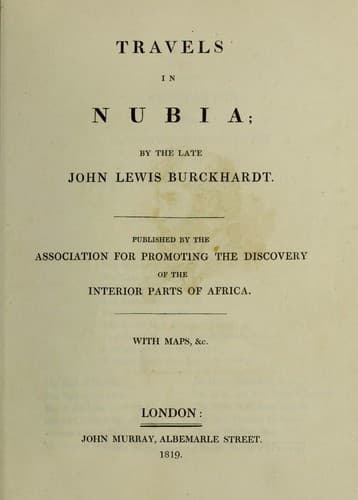
Burckhardt, John Lewis, 1784-1817; Nile River Valley -- Description and travel; Nubia -- Description and travel
In four hours and a half, we passed Wady Hadyd; opposite to which,
on the east side, is Wady Sahdab (وادي سهداب). On a rocky
hill stands an insulated column, the only remains of a small temple,
whose ruins are spread about; several small sepulchres are excavated
in the declivity of the hill, and heaps of rubbish indicate an
ancient city. Five hours, Djara (جعره). The shore from Tafa
to this place is well cultivated. Five hours and a half, Dehmyt,
where the Wady Mebarakat terminates. The eastern Dehmyt is better
cultivated than the western. Here are the foundations of a small
square edifice built of massy stones; with a thick mud wall running
parallel to the hills, and the course of the stream, for about fifty
yards; it was intended, perhaps, as a barrier against the sands of
the desert. In six hours and a half we came to Merys (مريس);
opposite to it, on the east side, is the village Syale. There is
an island in the river, with several brick ruins on it. The rock
is granite, and continues so all the way to Assouan. The road from
Syale lies over a sandy plain, with insulated hills of granite,
which separate it from the river. On the east side, to the north of
Syale, is the village of Abdoun. At seven hours and a half is Debot
(دبوت), consisting of several villages lying on both sides of the
river. At seven hours and three quarters is a hill, overhanging the
shore, and forming part of Wady Debot, on which are the ruins of an
Arab town; the houses are of brick, and seem to have been extensive,
and well built. In the river are several large granite piers. At the
end of eight hours, we halted for the night at a small hamlet. The
Mamelouks remained in this neighbourhood several months, till the
advance of Ibrahim Beg compelled them to retire: during that period,
fodder became so scarce, that they were obliged to feed their camels
upon the palm-leaves: they stripped all the date trees of their
leaves in this vicinity, and as far south also as Wady Halfa, so that
the Nubians were a whole year without any produce from the trees.
_March 30th._ After a ride of half an hour, over a well cultivated
plain, we came to the temple of Debot, which stands upon the site
of the ancient _Parembole_.
The temple is approached through three high, insulated gateways,
with projecting cornices, like that near Merowau. The distance
between the first and second gateway is twenty paces; ten paces
between the second and third; and fifteen paces between the third
and the pronaos of the temple. In front of the pronaos are four
columns, with a wall half their height. Along the centre of three
of the interior walls of the pronaos is a compartment of sculpture,
the other parts of the walls being quite bare; a peculiarity I
saw no where else. Adjoining the pronaos to the left is a square
chamber, the walls of which project beyond the side of the temple,
and destroy its symmetry. There are no sculptures of any kind on
the walls of this apartment.
[Illustration]
Public-domain text, read in full here on John Shaqi.
Reviews
Reviews
No reviews yet
Be the first to share your thoughts on this work.
Elsewhere in the archive
Join the Discussion
Join the discussion
Sign in to leave a comment or review.
Sign InorCreate an account