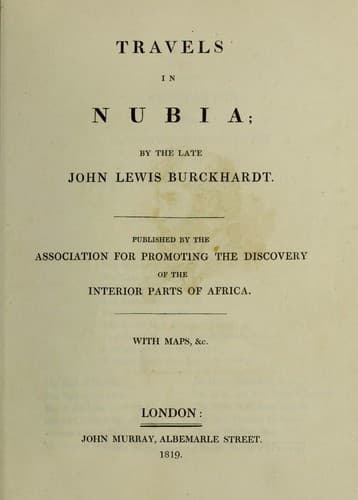
Burckhardt, John Lewis, 1784-1817; Nile River Valley -- Description and travel; Nubia -- Description and travel
The cella is an oblong square; its walls are covered with
hieroglyphics and sculptures: on one side of it is a dark apartment,
opening into the pronaos, and on the other side is a staircase
leading up to the top of the temple: below the staircase are several
small rooms. The adytum, which is entered through a narrow chamber,
three paces in breadth, is ten feet in length by nine in breadth;
in its posterior wall are two fine monolith temples of granite,
the largest of which is eight feet in height by three in breadth;
the winged globe is sculptured over each of them. They appear to have
been receptacles for some small sacred animals, perhaps beetles. The
places are yet visible where turned the hinges of the door, which
shut up whatever was contained within. These monolith temples are
similar to those at Philæ; but differ in their construction from
that at Gaou (_Antæopolis_), which is much larger:[59] nor are there
any hieroglyphics in the interior, whereas that at Gaou is covered
on the inside with inscriptions and sculptures, some of the latter
representing scarabæi. On each side of the adytum at Debot is a
small room, communicating with the narrow chamber behind the cella;
the walls of both are without sculptures, but contain some secret
recesses, similar to those at Kalabshe, and which were destined,
probably, for the same purposes. One of these rooms had an upper
story, like the one at Kalabshe, but it is now ruined; the other
apartments of the temple are in good preservation. The sculptures on
the inside walls are much defaced; but some faint remains of their
colouring are yet visible. There are no sculptures whatever on the
exterior walls. A wall, now in ruins, had encompassed the whole of
this temple, including the three gateways in front of it. I observed
in the broken-up floor of the pronaos deep stone foundations, upon
which the temple is built. I should not be surprised if subterraneous
rooms were discovered here, as well as in other Egyptian temples:
they would be quite in the spirit of the Egyptian hierarchy.
The temple of Debot appeared to me to have been built at an epoch
when the arts had begun to decline in Egypt. Its columns and
sculptures are imitations of those at Philæ, but far inferior
in beauty, to their models: the small temple at Merowau seemed to
be about the same age, though of more careful execution. We thus
find in Nubia specimens of all the different æras of Egyptian
architecture, the history of which indeed can only be traced in
Nubia; for all the remaining temples in Egypt (that of Gorne,
perhaps, excepted) appear to have been erected in an age when the
science of architecture had nearly attained to perfection. If I
were to class the Nubian temples according to the probable order of
their erection, it would be as follows: 1, Ebsambal. 2, Gyrshe. 3,
Derr. 4, Samne. 5, Ballyane. 6, Hassaya. 7, Seboua. 8, Aamara, and
Kalabshe. 9, Dakke, and Meharraka. 10, Kardassy. 11, Merowau. 12,
Debot. 13, Korty. 14, Tafa.
Public-domain text, read in full here on John Shaqi.
Reviews
Reviews
No reviews yet
Be the first to share your thoughts on this work.
Elsewhere in the archive
Join the Discussion
Join the discussion
Sign in to leave a comment or review.
Sign InorCreate an account