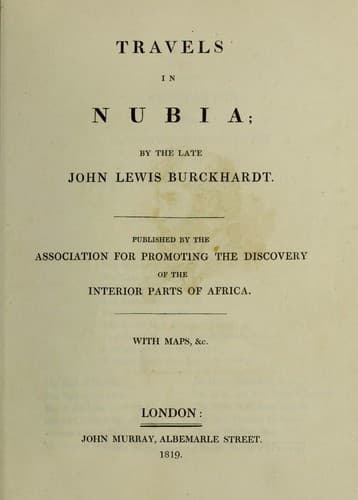
Burckhardt, John Lewis, 1784-1817; Nile River Valley -- Description and travel; Nubia -- Description and travel
of instances where they extorted upwards of twenty piastres from
strangers, by threatening to return with the boat to the main land,
and leave them upon the island. Birbe is under the government of
the Nubian chiefs. The territory of Assouan, belonging to Egypt,
commences to the north of Philæ.
I forbear making any remarks upon Philæ, or the adjoining island of
Bidge, as the great French work on Egypt has so thoroughly described
all the antiquities of that country.
I returned late in the evening to Assouan, where I found my servant,
who had begun to despair of my return. During the thirty-five days
I had been absent, I had rested only one day, on my first reaching
Derr; being in consequence a good deal fatigued, no less than the
camels, I determined to devote a few days to repose; I therefore
hired a room in the Okale, or public carawanserai, where I remained
five days, in the course of which, I visited at my leisure the
invirons of the town; the bed of the river was almost dry between
Assouan and the island of Elephantine, where I generally passed the
morning. The nilometer of Elephantine will continue to puzzle the
researches of travellers, as long as the high banks of the river
are covered with rubbish. The nilometer built by the Calif Maouya is
still extant. Near the extremity of the pier which forms the harbour
of Assouan is a square aperture as low as the river, with steps at
the bottom, by which the rise of the water might have been easily
determined; it now bears the name of Mekyas, (Nilometer). This pier
is not, as has been supposed by some travellers, a Roman bridge,
but a Saracen erection.
On the western shore, somewhat to the north of Assouan, is an
ancient convent; it stands on the declivity of the sandy hill upon
the summit of which is the saint’s tomb generally known by the name
of Kobbat el Howa, or the airy cupola. In the rocks below the convent
are several ancient temples and sepulchres, hewn out of the rock,
which have not been mentioned by any traveller. They are interesting
on account of their antiquity: each of them consists of a square
chamber, covered with hieroglyphics, in which are square pillars,
without capitals; the largest of these pillars measure two feet
and a half, and are fifteen feet in height; they are all of very
rude workmanship: in some of the temples are four, in others, six,
or eight pillars. The Greeks have made chapels of almost all these
temples. Large sepulchral excavations remain in several of them.
The ruined convent of St. Lawrence, on the west side of the river,
opposite to Assouan, little deserves the animated description which
Denon has given of it. On a tombstone lying on the floor of one
of its rooms, I read the following inscription, which I copied on
account of the rude and uncommon appearance of the characters.
[Illustration]
On the 9th of April, I returned to Esne.
Public-domain text, read in full here on John Shaqi.
Reviews
Reviews
No reviews yet
Be the first to share your thoughts on this work.
Elsewhere in the archive
Join the Discussion
Join the discussion
Sign in to leave a comment or review.
Sign InorCreate an account