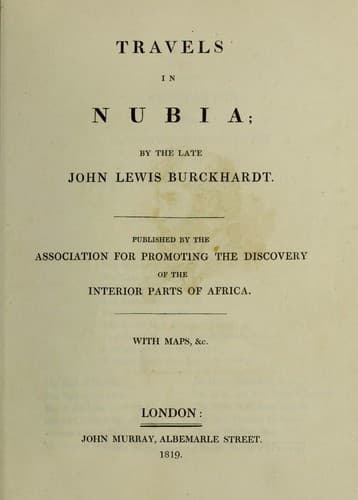
Burckhardt, John Lewis, 1784-1817; Nile River Valley -- Description and travel; Nubia -- Description and travel
I shall here subjoin a few general remarks upon the Nubians and
their history;[61] my stay among them was too short to enable me to
enter at length into the subject; and my observations were limited
by my ignorance of the Nubian language, in which all conversation
among the people, in my presence, was carried on.
I have already observed, that Nubia is divided into two parts,
called Wady Kenous, and Wady el Nouba (often named exclusively
Saÿd); the former extending from Assouan to Wady Seboua, and
the latter comprising the country between Seboua and the northern
frontier of Dóngola. The inhabitants of these two divisions are
divided by their language, but in manners they appear to be the same.
According to their own traditions, the present Nubians derive
their origin from the Arabian Bedouins, who invaded the country
after the promulgation of the Mohammedan creed,[62] the greater
part of the Christian inhabitants, whose churches I traced as far
as Sukkot, having either fled before them or been killed; a few,
as already mentioned, embraced the religion of the invaders, and
their descendants may yet be distinguished at Tafa, and at Serra,
north of Wady Halfa. The two tribes of Djowabere (جوابره)
and El Gharbye (الغربيه), the latter a branch of the great
tribe of Zenatye (زناتيه) took possession of the country from
Assouan to Wady Halfa, and subsequently extended their authority
over a great number of smaller tribes who had settled on the banks
of the river at the period of the general invasion, among whom
were the Kenous, a tribe from Nedjed and Irak.[63] The large tribe
of Djaafere occupied the shores of the Nile from Esne to Assouan;
a few families of Sherifs settled in the Batn el Hadjar; and a
branch of the Koreysh possessed themselves of Mahass. For several
centuries Nubia was occupied by these Arabs, who were at continual
war with each other, in the course of which the kings of Dóngola
had acquired so much influence over them, as to be able at last,
to compel them to pay tribute. The Djowabere having nearly subdued
the Gharbye, the latter sent an embassy to Constantinople, in the
reign of the great Sultan Selym, to seek aid against their enemies,
and they succeeded in procuring from the Sultan a body of several
hundred Bosnian soldiers, under a commander named Hassan Coosy. By
their means the Djowabere and people of Dóngola were driven
out of Nubia, into the latter country; and to this day the more
wealthy inhabitants of Dóngola derive their origin from the tribe
of Djowabere. Some families of the Djowabere, however, remained
peacefully behind, and their descendants, who are found chiefly at
Derr and Wady Halfa, are still known by the name of their ancestors.
Public-domain text, read in full here on John Shaqi.
Reviews
Reviews
No reviews yet
Be the first to share your thoughts on this work.
Elsewhere in the archive
Join the Discussion
Join the discussion
Sign in to leave a comment or review.
Sign InorCreate an account