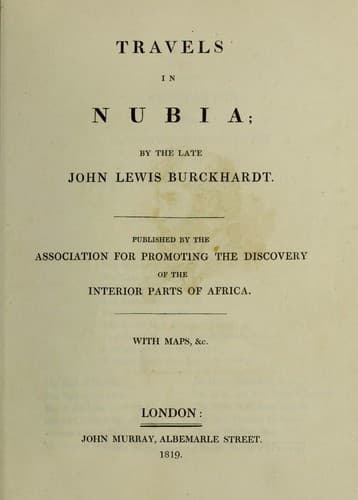
Burckhardt, John Lewis, 1784-1817; Nile River Valley -- Description and travel; Nubia -- Description and travel
About fifty years ago, Hamman, chief of the Howara Arabs, having
taken possession of the whole country from Siout to Assouan,
extended also his authority over Nubia, which he several times
visited, as far as Mahass; but, at present, the political state of
the country may be said to be, nominally at least, the same as when
Hassan Coosy took possession of it. The present governors, Hosseyn,
Hassan, and Mohammed, are his descendants; their father was named
Soleyman, and had acquired some reputation from his vigorous system
of government. The title of Kashef, assumed by the three brothers, is
given in Egypt to governors of districts. The brothers pay an annual
tribute of about £120. into the treasury of the Pasha of Egypt,
in lieu of the Miry of Nubia, for which the Pasha is accountable
to the Porte. In the time of the Mamelouks, this tribute was seldom
paid, but Mohammed Aly has received it regularly for the last three
years. The three Kashefs have about one hundred and twenty horsemen
in their service, consisting chiefly of their own relations, or
of slaves; these troops receive no regular pay; presents are made
to them occasionally, and they are considered to be upon duty only
when their masters are upon a journey. Derr is the chief residence
of the governors;[64] but they are almost continually moving about,
for the purpose of exacting the taxes from their subjects, who pay
them only on the approach of superior force. During these excursions,
the Kashefs commit acts of great injustice, wherever they find that
there is none to resist them, which is frequently the case. The
amount of the revenue is shared equally amongst the three brothers;
but they are all very avaricious, extremely jealous of each other,
and each robs clandestinely as much as he can. I estimate their
annual income at about £3,000. each,[65] or from 8 to £10,000. in
the whole. None of them spends more than £300. a year. Their
principal wealth consists in dollars and slaves. In their manners
they affect the haughty mien and deportment of Turkish grandees;
but their dress, which is worse than what a Turkish soldier would
like to wear, ill accords with this assumed air of dignity.
Public-domain text, read in full here on John Shaqi.
Reviews
Reviews
No reviews yet
Be the first to share your thoughts on this work.
Elsewhere in the archive
Join the Discussion
Join the discussion
Sign in to leave a comment or review.
Sign InorCreate an account