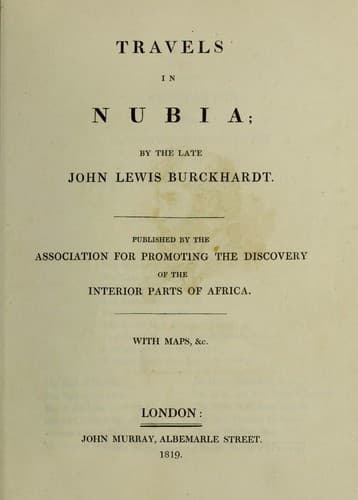
Burckhardt, John Lewis, 1784-1817; Nile River Valley -- Description and travel; Nubia -- Description and travel
If one Nubian happen to kill another, he is obliged to pay the debt
of blood to the family of the deceased, and a fine to the governors
of six camels, a cow, and seven sheep; or they are taken from his
relations. Every wound inflicted has its stated fine, consisting of
sheep and Dhourra, but varying in quantity, according to the parts
of the body wounded. This is an ancient Bedouin custom, and prevails
also among the people of Ibrim, with this difference, that the mulct
is given to the sufferer himself, and not to the Aga. If one of the
governor’s tribe, or an El Ghoz (الغُزّ a name given in Egypt
and Nubia to the Mamelouks) or any of the people of Ibrim is slain
by a Nubian, no debt of blood is paid to the family of the deceased,
he being considered a soldier, and not an Arab; but the governor
still exacts his fine. Much animosity exists between the Kenous,
and their southern neighbours the Noubas; the latter upbraiding
the former with avarice, and bad faith, while the Kenous call the
Noubas filthy slaves, living like the people of Soudan. Disputes and
sanguinary quarrels often take place, in consequence, between the
inhabitants of neighbouring villages; if death ensues, the family of
the deceased has the option of taking the fine stipulated on such
occasions, or of retaliating upon the family of the slayer. The
people of Ibrim generally claim the right of retaliation; but it
is not considered as sufficient to retaliate upon any person within
the fifth degree of consanguinity, as among the Bedouins of Arabia;
the brother, son, or first cousin only can supply the place of the
murderer, and such being the case, the whole family often flies.
Although the governors of Nubia extort large sums by the various
means above-mentioned, yet their tyranny is exercised only upon
the property of their subjects, who are never beaten or put to
death, except when in a state of open rebellion, which happens not
unfrequently.[68] If a Nubian, from whom money is to be extorted,
flies, his wife, or his young children, are imprisoned till he
returns. This practice is much complained of by the people, and
is unknown even among the tyrannical Pashas of Syria and Egypt,
who respect the persons of the wives and children of their greatest
enemies. The following is a curious method which the governors of
Nubia have devised, of extorting money from their subjects. When any
wealthy individual has a daughter of a suitable age, they demand
her in marriage; the father seldom dares to refuse, and sometimes
feels flattered by the honour; but he is soon ruined by his powerful
son-in-law, who extorts from him every article of his property
under the name of presents to his own daughter. All the governors
are thus married to females in almost every considerable village;
Hosseyn Kashef has above forty sons of whom twenty are married in
the same manner.
Public-domain text, read in full here on John Shaqi.
Reviews
Reviews
No reviews yet
Be the first to share your thoughts on this work.
Elsewhere in the archive
Join the Discussion
Join the discussion
Sign in to leave a comment or review.
Sign InorCreate an account