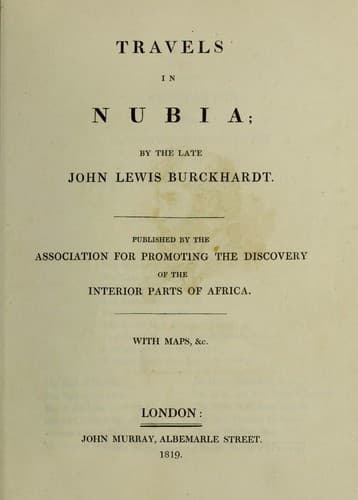
Burckhardt, John Lewis, 1784-1817; Nile River Valley -- Description and travel; Nubia -- Description and travel
The inhabitants of the banks of the Nile, from the first Cataract
to the frontiers of Dóngola, do not plough their fields, after the
inundation has subsided, as is done in Egypt; the waters above the
Cataract never rising sufficiently high to overflow the shore. In
a few places, where the cultivable soil is broader than usual,
as at Kostamne, Gyrshe, Wady Halfa, &c., there are canals which
convey the water towards the fields on the side of the mountain,
but the water in them is not sufficiently high, as in Upper
Egypt, to irrigate the low grounds near the hills. Irrigation in
Nubia, therefore, is carried on entirely by means of the Sakies,
or water-wheels. Immediately after the river has subsided, the
fields are watered by them, and the first Dhourra seed is sown,
the crop from which is reaped in December and January; the ground
is then again irrigated, and barley sown; and after the barley
harvest, the ground is sometimes sown a third time for the summer
crop. The barley is either sold in exchange for Dhourra, or eaten
green in soups. The harvest suffers greatly from the ravages of
immense flocks of sparrows, which the united efforts of all the
children in the villages cannot always keep at a distance; and
whole fields of Dhourra and barley are often destroyed by a species
of small worm, which ascends the stalks of the plant. Tobacco is
every where cultivated; it retains, when dried, its green colour,
and exactly resembles that of the mountains on the east side of
the Dead Sea. Tobacco forms the chief luxury of all classes, who
either smoke it, or mixing it with nitre suck it, by placing it
between the lower gums and the lip.
The habitations of the Nubians are built either of mud or of loose
stones; those of stone, as I have already observed, stand generally
on the declivity of the hills, and consist of two separate round
buildings, one of which is occupied by the males, and the other by
the females of the family. The mud dwellings are generally so low,
that one can hardly stand upright in them: the roof is covered with
Dhourra stalks, which last till they are eaten up by the cattle,
when palm leaves are laid across. The houses at Derr, and those
of the wealthy inhabitants of the larger villages, are well built,
having a large area in the centre with apartments all round, and a
separation between those of the men and of the women. The utensils
of a Nubian’s house consist of about half a dozen coarse earthen
jars, from one to two feet in diameter, and about five feet in
height, in which all the provisions of the family are kept; a few
earthen plates; a hand-mill; a hatchet; and a few round sticks,
over which the loom is laid.
Public-domain text, read in full here on John Shaqi.
Reviews
Reviews
No reviews yet
Be the first to share your thoughts on this work.
Elsewhere in the archive
Join the Discussion
Join the discussion
Sign in to leave a comment or review.
Sign InorCreate an account