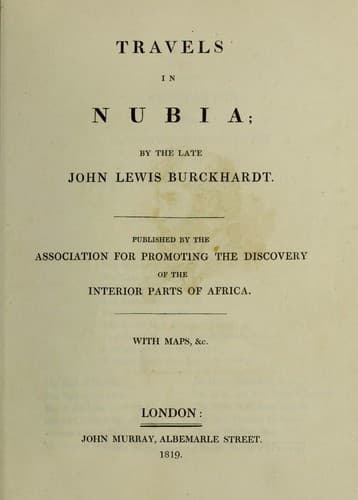
Burckhardt, John Lewis, 1784-1817; Nile River Valley -- Description and travel; Nubia -- Description and travel
[Footnote 4: There are two species of Holcus cultivated in Egypt,
nearly resembling one another in appearance before they ripen, but
bearing a very different kind of grain, the one being that which we
commonly call Maize or Indian corn, the other a small grain like
millet, the same which is known in the West Indies by the name
of Guinea corn. Maize being suited to a more northerly climate,
is little grown in Upper Egypt, where it is known by the name of
Dhourra es-Shamy (Syrian Dhourra). In Nubia the millet-grained
Dhourra is exclusively cultivated.]
[Footnote 5: Since the Mamelouks have retired to Dóngola, Mohammed
Aly, the Pasha of Egypt, has prohibited the sale of gunpowder
in every part of Upper Egypt. He has thus cut off his enemies’
ammunition, who pay at present, in Dóngola, one slave for every
six dozen of musquet cartridges.]
[Footnote 6: Vide infra.]
[Footnote 7: From March till June the waters of the Nile are quite
limpid. Volney, who exclaims against its muddy stream, saw it only
in autumn and winter.]
[Footnote 8: Vide infra.]
[Footnote 9: This is the only spot, where I know the Nile to be
fordable.]
[Footnote 10: A Highlander, who had been taken prisoner in the
unfortunate affair at Rosetta, in 1807, and had afterwards joined
the Mamelouks, has lately arrived at Cairo. He left the Mamelouks
at Dongola, and traced his way back, alone, through Nubia and Upper
Egypt, notwithstanding the spies of the Pasha.]
[Footnote 11: One of the servants of these Begs, a Greek Christian
of Brusa, in Asia Minor, assured me afterwards, at Derr, that their
party, being unable to forego the habit of smoking, had, in a total
want of tobacco, in the mountains, filled their pipes with the dry
dung of the Gazells.]
[Footnote 12: Concerning this tribe, and their language, vide infra.]
[Footnote 13: I have since been in the mountains of Sinai, where
I found another tribe of Bedouins, called Aleykat, settled in the
southern valleys of that province. They all affirmed that the Aleykat
of Nubia were their brethren, and originally a colony from them. Some
years since, a poor man of the Sinai Aleykat took the resolution
of visiting those of Nubia, and of collecting a few presents:
he was well received at Wady Seboua, as one of their brethren,
and returned with several camels, purchased with the alms he had
obtained from every family in that place.]
Public-domain text, read in full here on John Shaqi.
Reviews
Reviews
No reviews yet
Be the first to share your thoughts on this work.
Elsewhere in the archive
Join the Discussion
Join the discussion
Sign in to leave a comment or review.
Sign InorCreate an account