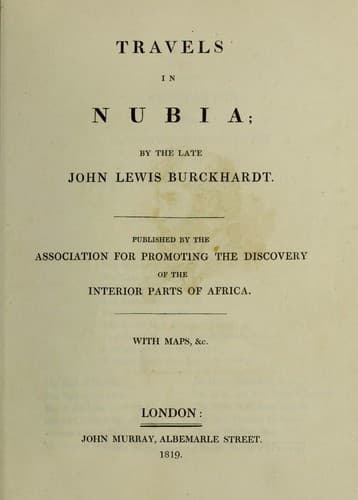
Burckhardt, John Lewis, 1784-1817; Nile River Valley -- Description and travel; Nubia -- Description and travel
[Footnote 14: A caravan of from thirty to forty laden camels proceeds
every winter from Seboua to Cairo. The merchants of Seboua are
accustomed to enter into partnership with the poor Nubians; to whom
they advance sums of money, to induce them to try a trading journey
to Berber, and on their return take half the profits. There are
families who have thus been mutually travelling partners from time
immemorial. The distance between Seboua and Mograt, on the Nile,
north of Berber (vide infra), is seven days easy travelling. Three
days from Seboua is a large well called Rebt (ربت); and another
at five days journey.]
[Footnote 15: In all these parts soap is a very acceptable present,
none being made in Egypt, except at Siout, which is of a very
inferior quality. It is imported from Syria, and principally from
Palestine. At Esne, one pound of soap is worth 1_s_. 6_d_.]
[Footnote 16: This grain is not sown in Egypt, but is a principal
food in Darfour, Sennaar, and on the coast of the Red Sea, from
Djidda to Mokha.]
[Footnote 17: All Orientals have a delicate taste of water, and
generally describe its qualities by the words light and heavy. The
Greeks in like manner distinguished waters into κοῦφα and
βαρέα.]
[Footnote 18: The Doum (Palma Thebaica) is a common tree in Egypt
as far north as Dendera.]
[Footnote 19: Vide my Journal in Hauran.]
[Footnote 20: The inhabitants of Nouba, and Wady Kenous, as
far as Dongola, are known in Egypt under the name of Berábera
(sing. Berbery); but that appellation is seldom made use of by the
inhabitants themselves, when speaking of their own nation. It is
probably derived from the name of the country called Berber, which
lies in the direction of Bruce’s Goos. The people of Berber are
sometimes considered as belonging to the Nouba.]
[Footnote 21: The descendants of many Bedouin tribes are found in
every part of Egypt north of Minia; the greater part of the peasants
of Upper Egypt are of Bedouin origin; and branches of several Syrian
tribes, have even settled on the banks of the Nile.]
[Footnote 22: Statues are met with in the adyta of all the ancient
temples in Nubia which are cut out of the rock; and the distribution
of the apartments in those temples is much the same as in the one
here described.]
[Footnote 23: Vide infra.]
[Footnote 24: Vide infra.]
[Footnote 25: See p. 12.]
[Footnote 26: I never heard the Nubians speak of crocodiles of
a monstrous size; I conceive that the largest I saw was about
twenty-five feet in length. Crocodiles as large as that in the
British Museum, are met with on the Nile only in the latitude of
Shendy and Sennaar.]
[Footnote 27: Akabe is a term very frequently met with in Arabian
geography; it generally designates a mountainous district, or a
rocky descent, over which the road lies.]
[Footnote 28: Vide my Journal through Arabia Petræa.]
[Footnote 29: See p. 31.]
[Footnote 30: Vide infra.]
Public-domain text, read in full here on John Shaqi.
Reviews
Reviews
No reviews yet
Be the first to share your thoughts on this work.
Elsewhere in the archive
Join the Discussion
Join the discussion
Sign in to leave a comment or review.
Sign InorCreate an account