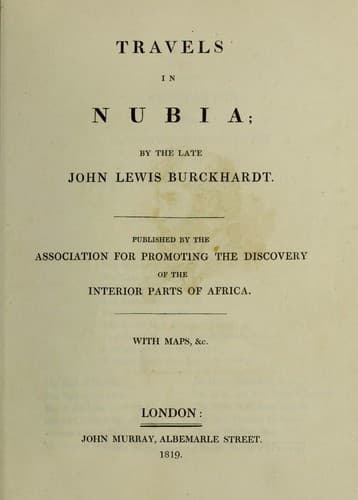
Burckhardt, John Lewis, 1784-1817; Nile River Valley -- Description and travel; Nubia -- Description and travel
[Footnote 44: When at Esne in the June following, I saw persons from
Dóngola, who brought intelligence that the Mamelouks had failed
in their attempt against Merawe, and had returned to Dóngola.]
[Footnote 45: See p. 55.]
[Footnote 46: See p. 52.]
[Footnote 47: See p. 47.]
[Footnote 48: The Arabian historians and geographers give the
cataracts of the Nile the appellation of Shellal, or Djenadel
(شلّال), (جنادل). Of the latter generic term, the proper
name, Jan Adel, has been framed, and applied exclusively to this
cataract, on European maps.]
[Footnote 49: The reports of my guide, and of many other persons,
had made me very anxious to see the second Cataract, the water of
which, I was told, “fell down, as if from heaven!” When, after
seeing it, I reprimanded my guide for his extravagant description,
he replied, “Why, have you seen a finer cataract, from Cairo to
Mahass?” But the reports of these people are still less to be
depended upon than even those of the Syrian Arabs. I was told by
many Nubians that the distance from Derr to Mahass was sixteen days
and nights journeys; but I found it to be only ten; they in like
manner endeavoured to deceive me, in numberless other instances,
whenever I asked questions which appeared to them out of the common
course of conversation, the continual topic of which is, the price
of dates and Dhourra, the taxes on the water-wheels, and complaints
on the injustice of the governors.]
[Footnote 50: The word dromedary is here used (according to a custom
general among the _Franks_ in the Levant), to distinguish the camel
of lighter make, fit for riding, from the camel of burthen.]
[Footnote 51: A sort of shawl worn about the neck and shoulders by
the Egyptians.]
[Footnote 52: See p. 17.]
[Footnote 53: It is a curious fact, which has been attested to me by
many persons, that the small-pox has never been known to visit the
Wady Kenous or the narrow shore from the Cataract up to Korosko. This
disease is well known at Derr, where it is much dreaded.]
[Footnote 54: This narrow room behind the pronaos is peculiar to
some of the temples of Nubia; I have not seen it in Egypt; nor do
I know whether I should be right in calling it the cella.]
[Footnote 55: In Nubia the figure of Briareus has the hair of the
head cut like that of the Arabs and the Noubas, with rings in the
ears, exactly resembling the Noubas and inhabitants of Mahass at the
present day. It is possible that the Briareus may have originated
in some great chieftain of the desert, vanquished by the king of
Egypt, and converted by the priests into a many-headed monster,
in conformity with an adage current in the East, in speaking of the
Bedouin robbers, “Cut off one head and a hundred will spring up
in its stead:” (اقطع راس الواحد تطلع ماية
عَوضَه).]
Public-domain text, read in full here on John Shaqi.
Reviews
Reviews
No reviews yet
Be the first to share your thoughts on this work.
Elsewhere in the archive
Join the Discussion
Join the discussion
Sign in to leave a comment or review.
Sign InorCreate an account